
Morning production numbers do not match yesterday’s report. Planning calls store for clarification. Someone checks another version of the file. What started as simple Excel for Manufacturing slowly becomes daily coordination work. This is how many manufacturing workflow problems start – quietly, without a clear breaking point.
Why Excel for Manufacturing Breaks at Scale?
- Multiple users updating the same file without control.
- Manual handover between planning, store, and production.
- No enforced workflow or approval trail.
- Reporting depends on consolidation, not live data.
As teams grow, Excel for Manufacturing struggles to coordinate multiple departments in real time, and small mismatches begin to expose deeper structural weaknesses. What worked for 10–15 staff becomes fragile at 30–50 staff because spreadsheets do not enforce workflow discipline.
Growth Exposes Structural Weakness
Most manufacturing companies did not choose the wrong tool. Excel was practical when the team was small, the product range limited, and decisions could be confirmed verbally. It supported early growth because processes were still simple and closely managed by a few experienced people.
The strain appears when volume increases, departments expand, and coordination depends on multiple files instead of shared workflow. The issue is not carelessness. It is structural. And when structure is weak, knowledge quietly shifts from system to individual.
This is the turning point where Excel for Manufacturing stops being a helpful tool and starts contributing to manufacturing workflow problems — the stage where many owners begin seriously evaluating whether an ERP for manufacturing industry is structurally necessary rather than optional.
Knowledge Becomes Staff-Dependent
When workflow is managed through spreadsheets, logic lives inside formulas and personal habits. One planner knows which tab to update first. One store supervisor remembers which column not to touch. Over time, the process becomes dependent on memory rather than structure.
The risk surfaces when someone resigns or goes on leave. Files are still there, but the sequence is unclear. New staff follow old formats without understanding the reasoning. Gradually, operational knowledge shifts from company asset to individual possession, increasing fragility without anyone intending it. The spreadsheet still exists, but the workflow logic is no longer transparent or transferable.
Delays Distort Production Decisions
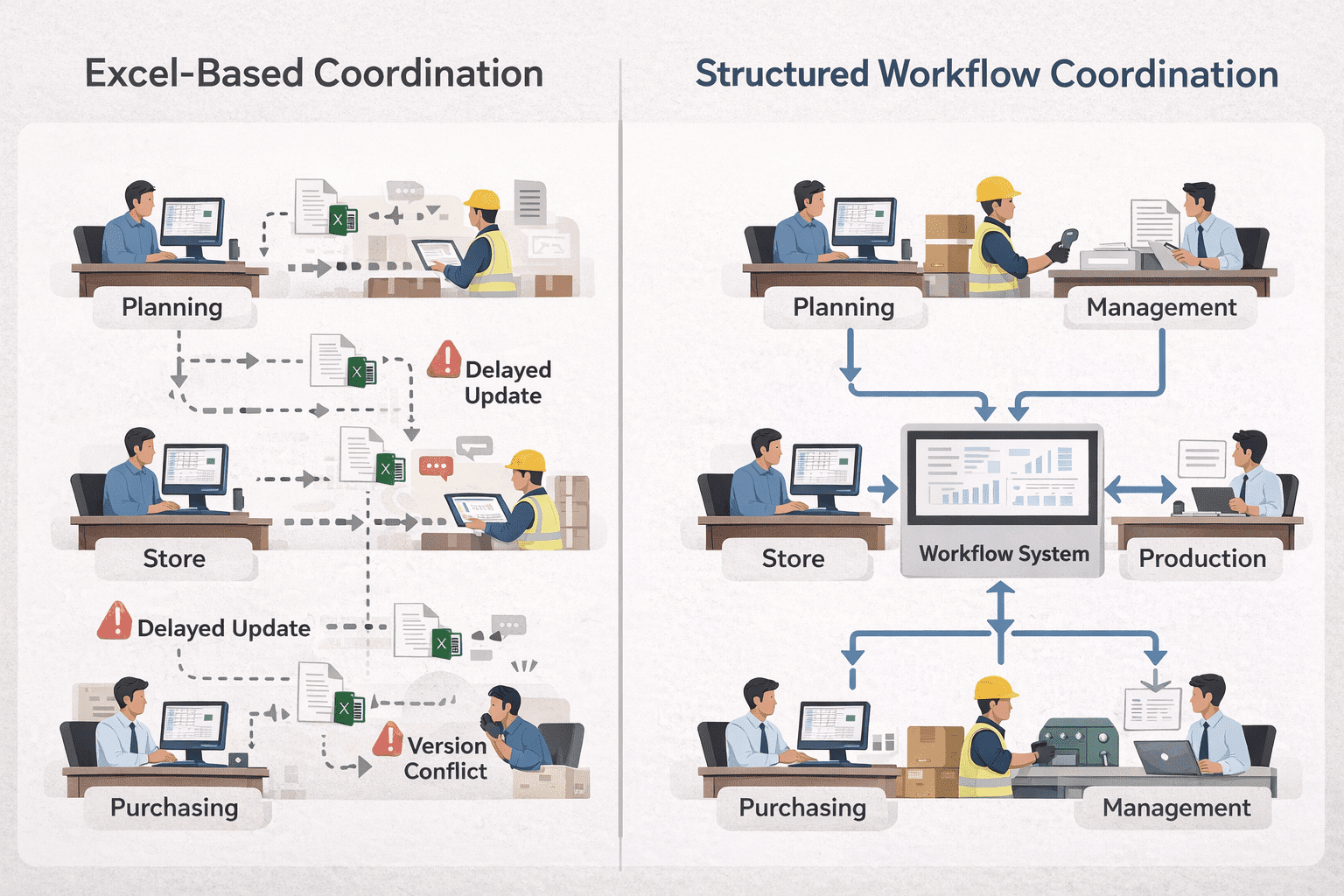
In many factories, decisions rely on yesterday’s numbers. Stock balances are updated at the end of the day. Production output is consolidated manually before reporting. By the time management reviews the figures, reality has already moved forward.
Small timing gaps create distorted signals. Purchasing reacts to outdated demand. Production plans based on incomplete stock data. Supervisors compensate through phone calls and WhatsApp confirmations. What looks like control is often correction work, and planning slowly becomes reactive rather than structured. Over time, these timing gaps compound into larger manufacturing workflow problems that are difficult to trace back to their origin.
Error Costs Are Often Invisible
Not every error is dramatic. A wrong stock figure may only cause slight over-ordering. A missed update may delay one batch. These issues feel manageable in isolation, so they are absorbed into daily operations.
But repeated small mismatches accumulate. Extra inventory ties up cash. Overtime increases to catch up. Delivery dates shift quietly. Because the impact spreads across departments, the financial effect is rarely traced back to the workflow itself. Over time, the cost is real, even if it is not clearly visible. Excel for Manufacturing rarely fails dramatically; it leaks value slowly through coordination inefficiencies and minor data mismatches.
Financial Exposure Increases Quietly
When small operational errors accumulate, the impact moves beyond the shop floor. Working capital becomes tied up in excess stock. Margins shrink due to unplanned overtime and rework. Management reports appear stable, yet the underlying numbers carry hidden adjustments and assumptions.
From an owner’s perspective, this is not only about workflow efficiency. It is about risk visibility, which is why discussions around ERP for SME should focus on operational control and financial transparency rather than software features.
If data reliability is uncertain, forecasting becomes weaker, expansion decisions become cautious, and confidence reduces over time. Before discussing tools or systems, it is necessary to address the structural fragility beneath daily operations. Without structural correction, manufacturing workflow problems eventually surface in cash flow, margin pressure, and slower strategic decisions.
Replace Fragility with Workflow Structure
Stability does not require a sudden overhaul. It begins with understanding where coordination breaks and restoring structure step by step. A phased approach reduces disruption. Clarity before commitment controls scope.
Risk is managed by strengthening one workflow at a time, instead of attempting to replace everything at once. A principle often overlooked when selecting enterprise resource planning systems is based purely on feature lists instead of real workflow fit. The objective is not to eliminate Excel immediately, but to reduce dependency on uncontrolled coordination.
Clarity Before Expansion
Daily chaos is rarely about careless staff. It is usually a signal that structure has not grown at the same pace as the business. Excel for Manufacturing may continue running, but its limits become visible when coordination depends on memory and manual control. When daily firefighting becomes normal, the operational ceiling has already appeared. Before expanding capacity or product range, it is worth examining whether your workflow can support the next stage without increasing hidden financial exposure.
If this situation feels familiar, you may reach out to me privately via WhatsApp or email. A short discussion to assess workflow risks and decision scope is often more valuable than jumping straight into system proposals. The goal is clarity before commitment.
—
Ning
Founder, Zoomo Tech