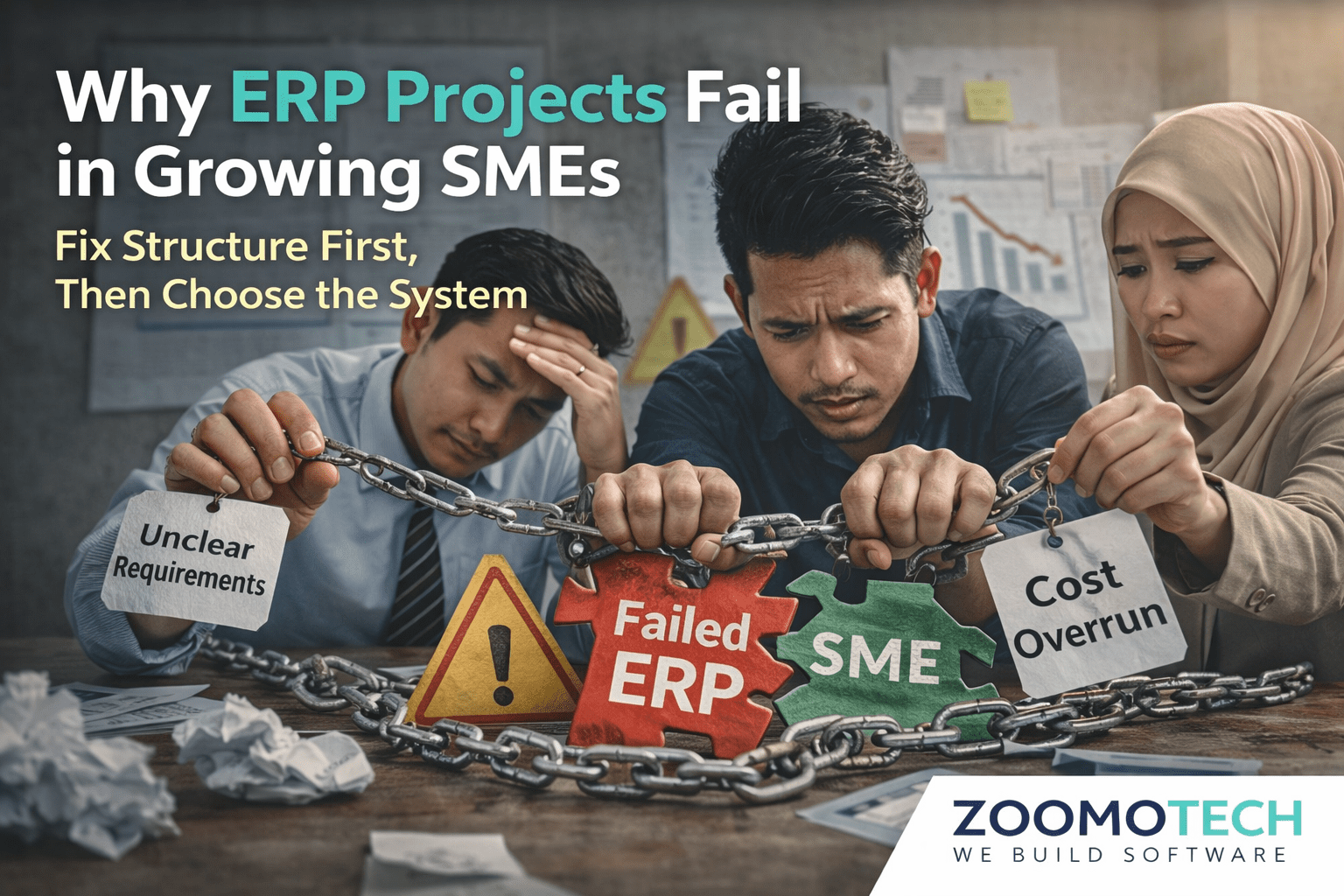
ERP Projects Fail not during go-live, but much earlier. A Malaysian SME starts with high expectations, but small gaps appear such as unclear requirements, mismatched workflows, delayed decisions. Teams assume it is normal. Only when costs rise and operations slow down does management realise something is already going wrong.
Why ERP Projects Fail in Malaysian SMEs
ERP Projects Fail mainly due to early misalignment between business reality and system expectations, when structure and clarity are not established early.
- Workflow does not match actual operations
- Requirements unclear from the start
- Vendor assumptions not validated
- No phased implementation approach
- Operational disruption underestimated
ERP Adoption Rises Faster Than Implementation Maturity
Many Malaysian SMEs move into ERP not because they are fully ready, but because growth starts creating pressure. Reporting slows down, coordination becomes harder, and management begins to feel the limits of manual control. ERP is then seen as the next step, even though internal processes are still informal or undocumented, especially when basic process structure such as ISO 9001 quality management principles is not yet in place.
At the same time, vendors often move quickly into system discussions before fully understanding daily operations. This creates a gap between what management expects and how the business actually runs. The issue is not the decision to adopt ERP, but the timing of starting before the business problem is clearly structured
Unclear Requirements Distort the Entire Project Direction
Most ERP discussions start at a high level such as modules, reports, and features, but actual daily operations are rarely broken down in detail, similar to how visibility gaps appear in manual-based reporting. Important edge cases, such as exceptions in production or last-minute order changes, are often missed. Teams assume these can be handled later, but those assumptions quietly shape the entire project direction.
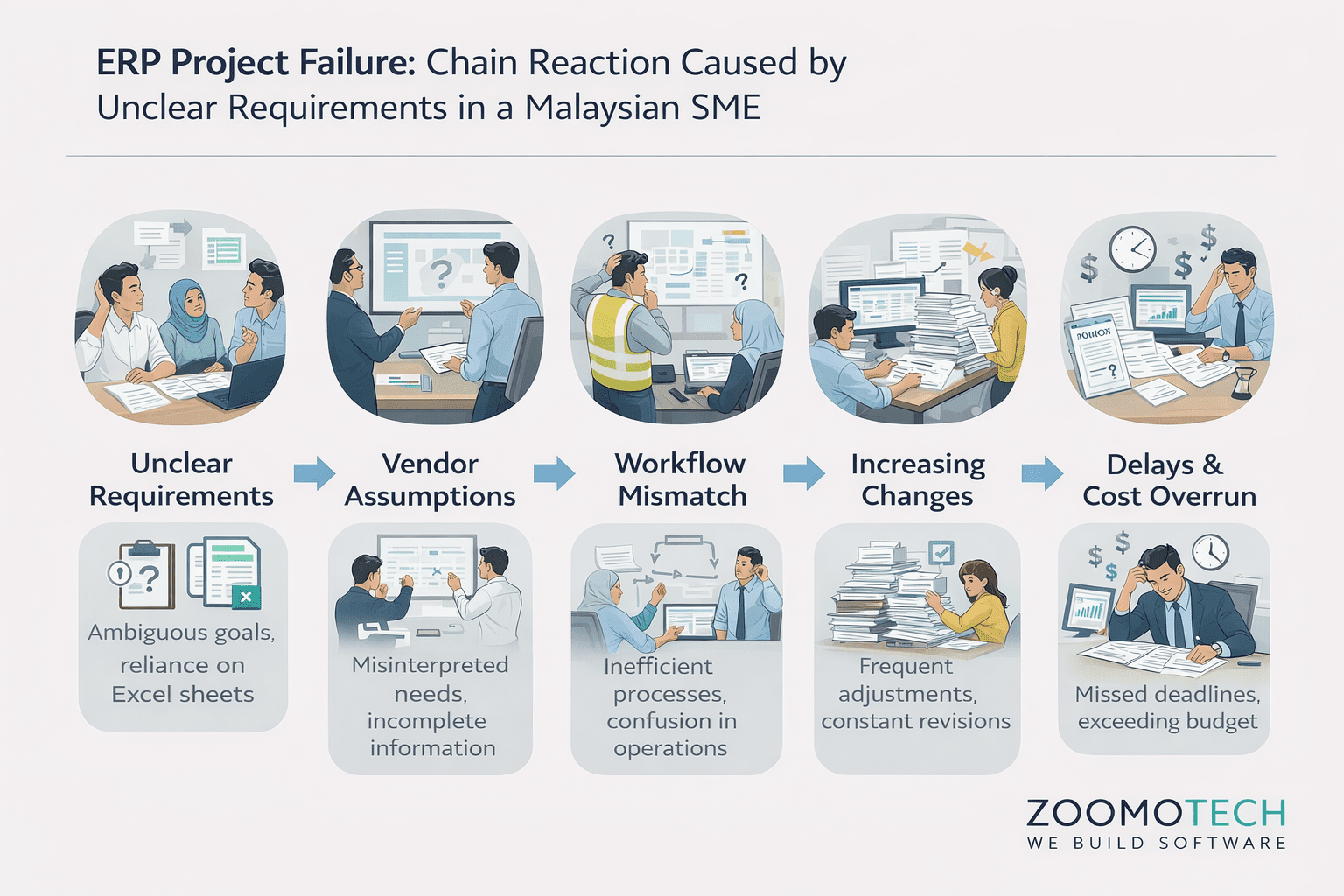
As development progresses, gaps begin to surface. Change requests increase, timelines extend, and costs start drifting. What looked clear at the beginning becomes uncertain, not because the system is wrong, but because the foundation was never fully defined.
ERP Systems Force Workflows That Do Not Fit
Most standard ERP systems are designed based on general industry practices. However, Malaysian SMEs often operate with customised workflows built over years of practical adjustments, especially in environments where Excel for manufacturing starts causing daily coordination issues. When these workflows are forced into a rigid system, the mismatch becomes visible almost immediately.
Teams then adapt by creating workarounds which including manual tracking, side records, or bypassing certain steps. Over time, this creates friction between departments. The system exists, but operations still rely on informal methods, which reduces the value of the implementation over time.
Implementation Scope Expands Beyond Initial Control
At the start, project scope is usually defined based on limited understanding. As the system begins to take shape, more requirements emerge from different departments. Each addition may seem reasonable, but without structured control, the scope gradually expands beyond the original plan.
This creates a moving target. Timelines become harder to manage, and priorities shift frequently. In some cases, vendors may continue accommodating changes without clear boundaries. The project becomes increasingly complex, making it difficult for management to maintain control.
Operational Disruption Is Underestimated by Management
While implementation is ongoing, daily operations do not stop. Staff are expected to learn new processes while continuing their existing responsibilities. This often slows down productivity, especially during the transition period.
Under pressure, resistance begins to build. Some teams revert to old methods, while others attempt to manage both systems in parallel. This creates confusion and inconsistency. What was intended to improve efficiency can temporarily reduce it, affecting output and coordination across teams.
Lack of Ownership Creates Decision Delays and Confusion
ERP projects often involve multiple departments, but without a clear internal owner, decision-making becomes fragmented. Each department may have different priorities, leading to conflicting requirements and unclear direction.
Vendors are then left waiting for confirmation, while internal discussions continue without resolution. Decisions get delayed, revised, or reversed. Over time, this slows project momentum and increases uncertainty, making it difficult for management to move forward with confidence.
Cost Overrun Happens After Commitment Becomes Irreversible
As these issues accumulate, the project reaches a stage where stopping is no longer practical. Time, money, and internal effort have already been committed. Management faces a difficult position, which either continue investing to “fix” the system or accept partial failure. This is where many ERP Projects Fail quietly, not due to one wrong decision, but due to accumulated commitments over time.
Additional budget is often approved with hesitation, driven more by necessity than confidence, especially when growth has already started exposing operational limits in the business. At this stage, ROI becomes unclear, and pressure shifts to management. The concern is no longer system performance, but whether the business can regain control without further disruption.
ERP Should Follow Business Structure Not Replace It
ERP does not need to start big to be effective. The safer path is to first clarify how the business actually runs, then introduce structure gradually. When systems follow real workflows, user adoption becomes more natural. A phased approach reduces risk, allows validation, and keeps control in management hands instead of assumptions.
Clarity Before Commitment Prevents Most ERP Failures
ERP projects do not fail because SMEs make wrong decisions, but because key decisions are made too early without sufficient clarity. Most ERP Projects Fail when assumptions replace understanding. A structured approach is starting small, validating along the way, and aligning system with real operations, this reduces risk significantly. When clarity comes first, cost, timeline, and expectations become more controlled, allowing management to make decisions with confidence instead of reacting under pressure.
If some of these situations feel familiar, it may be worth having a short discussion before moving further. Sometimes a second opinion can help clarify risks or options early. No pressure but just a practical conversation to understand your situation better. You are welcome to reach out via WhatsApp or Email to explore this further.
—
Ning
Founder, Zoomo Tech