
When a quality issue surfaces, manufacturers need to answer one question fast: exactly which products are affected, and why? Manufacturing traceability refers to the process of recording and tracking products throughout the manufacturing lifecycle.
For manufacturers in regulated industries, global supply chains, or high-quality-standard markets, traceability is the foundation of responsible manufacturing, ensuring that customers have documented confidence in the products they receive. In this overview, we’ll explore what is traceability in manufacturing, why it matters, how it works, and the role traceability software plays in supporting modern manufacturing operations.
What is Manufacturing Traceability?
Manufacturing traceability is the ability to identify, record, and retrieve the full history of a product across its entire production lifecycle. It connects a finished product back to the raw materials it was made from, the processes it went through, the equipment used, and the people or systems involved at each stage.
In practice, traceability means being able to answer questions such as:
- Where did this component come from?
- Which production line processed this batch?
- Were quality checks completed and passed?
- Has this product been modified or reworked?
- Where has this item been shipped or stored?
Traceability works by assigning unique identifiers to materials, components, and finished goods, then recording data at each production step that links those identifiers to process records, test results, timestamps, equipment IDs, and operator information.
Why is Manufacturing Traceability Important?
- Faster Recalls and Issue Resolution: When a quality issue is identified, traceability allows manufacturers to pinpoint exactly which batches, materials, or production runs are affected. This reduces recall costs and limits disruption to customers and operations.
- Improved Quality Management: Traceability creates a complete record of the production process, making it easier to perform root cause analysis, identify recurring issues, and improve product quality over time.
- Reduced Waste and Greater Efficiency: By identifying where defects or process deviations occur, manufacturers can address problems earlier, reducing scrap, rework, and operational inefficiencies.
- Supply Chain Tracking: Traceability extends beyond the factory floor. By linking supplier, material, and production data, manufacturers gain better tracking into supplier performance and potential supply chain risks.
- Regulatory Compliance: Many industries require traceability to meet quality and safety standards. Frameworks such as ISO 9001:2015 emphasise maintaining documented information and traceability records to demonstrate product conformity and process control.
- Support for Smart Manufacturing: As Malaysia advances under initiatives such as NIMP 2030, traceability is becoming a foundational capability for manufacturers pursuing digitalisation, process transparency, and Industry 4.0 readiness.
- Customer and Market Confidence: For buyers in demanding sectors such as medical devices, electronics, or food, supplier traceability is increasingly a qualification requirement. Demonstrating robust traceability strengthens commercial relationships and supports market access.
The Different Types of Manufacturing Traceability
1. Chain Traceability
Chain traceability, also known as supply chain traceability, tracks materials and products as they move between organisations and supply chain stages.
What it tracks:
- Material origins and supplier information
- Transportation and logistics records
- Distribution and delivery destinations
- Customer and retailer records
Why it matters:
- Improves supplier quality management
- Supports recalls and investigations
- Helps meet import, export, and regulatory requirements
- Provides documented product provenance
2. Internal Traceability
Internal traceability focuses on what happens within a manufacturing facility as materials move through production.
What it tracks:
- Material and component movements
- Machines and equipment used
- Process parameters and production records
- Operators and technicians involved
- Quality inspections and test results
Why it matters:
- Supports root cause analysis
- Improves quality management
- Reduces waste and rework
- Facilitates compliance and audits
In practice, both forms of traceability are typically managed through a manufacturing traceability system.
How Does Manufacturing Traceability Work?
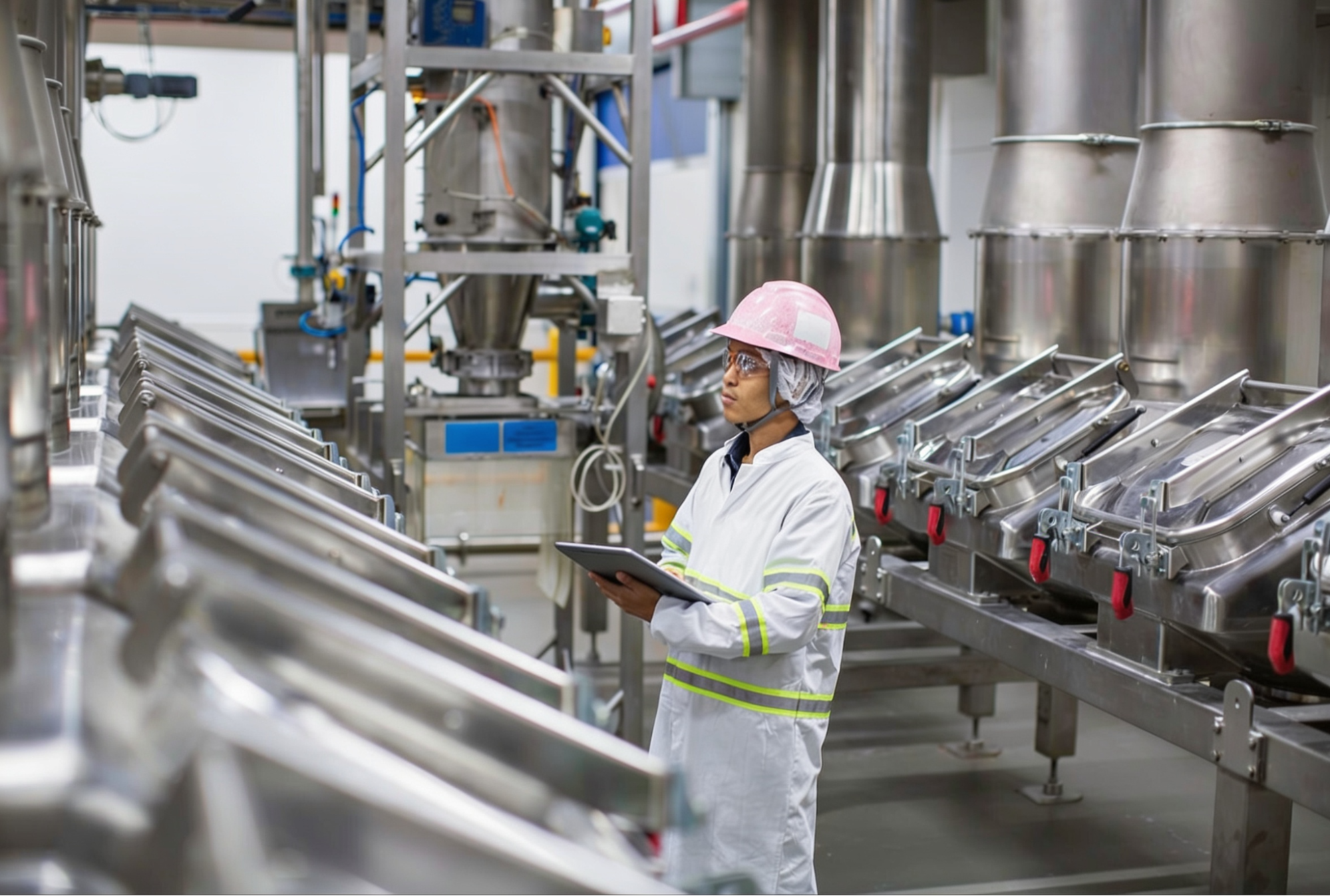
The process of manufacturing traceability follows a series of data capture and tracking activities throughout production. While the exact implementation varies by manufacturer, the core steps typically remain the same.
The process typically follows this sequence:
- Identification: Each item or batch is assigned a unique identifier, typically a barcode, QR code, RFID tag, or serial number. This identifier travels with the item throughout its production journey.
- Data capture: At each production stage, data is recorded and linked to the item’s identifier. This may include timestamps, machine IDs, operator IDs, process parameters, material lot numbers, inspection results, and environmental readings.
- Linkage: The captured data is linked together in a system that allows users to trace forward (where did this item go?) or backward (where did this item come from?). This bidirectional traceability is what gives the system its value.
- Storage and retrieval: Records are stored in a centralised system, whether a Manufacturing Execution System (MES), Enterprise Resource Planning (ERP) system, or dedicated traceability platform. Authorised users can retrieve complete production histories when needed.
- Analysis and reporting: Traceability data supports quality analysis, compliance reporting, customer documentation, and continuous improvement activities.
Manufacturing Traceability and Product Identification
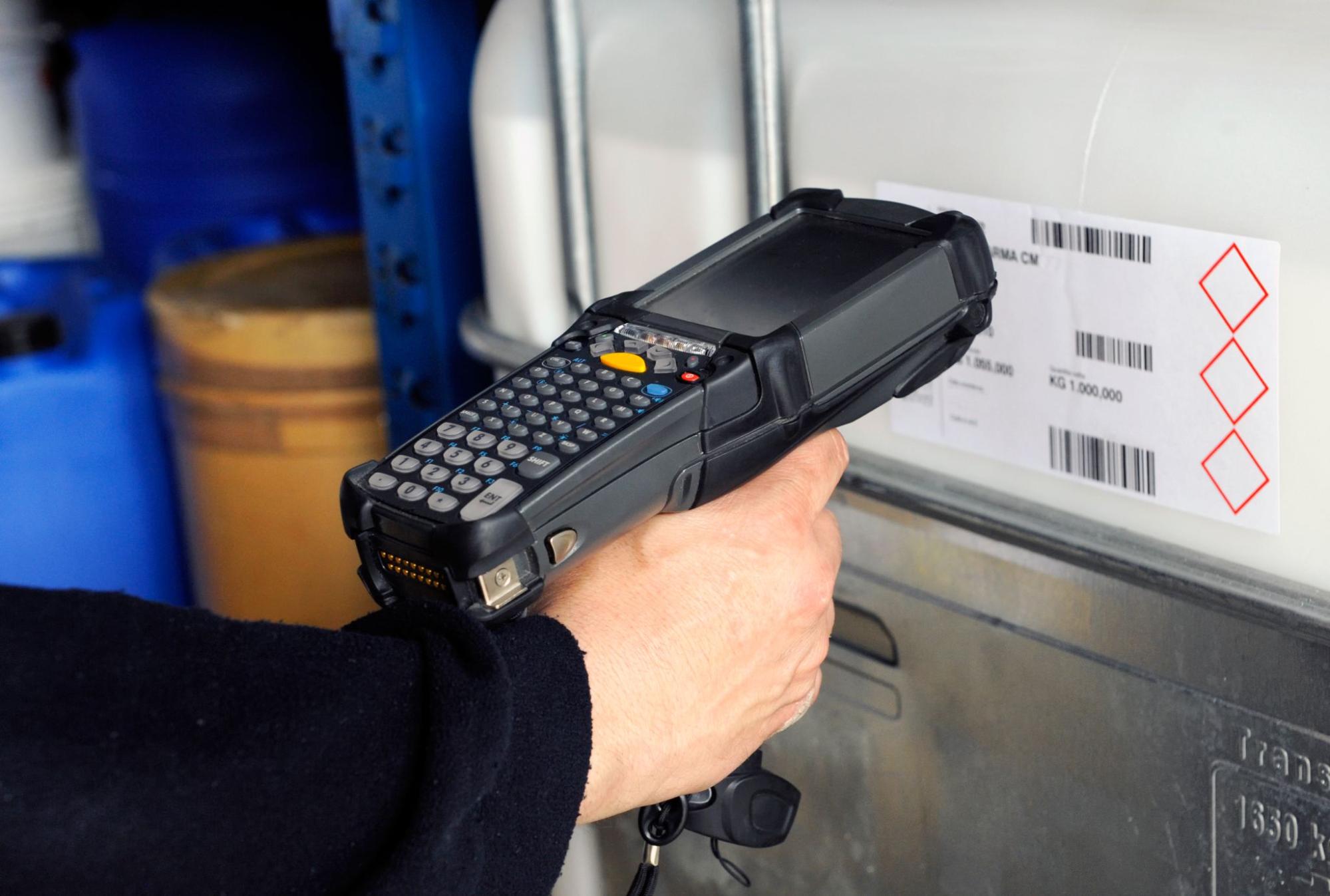
Effective traceability starts with reliable product identification. Every item, component, or batch must have a unique identifier that allows data to be linked across production stages.
Common identification methods include:
- Barcodes: The most widely used option. Traditional 1D barcodes store a simple identifier, while 2D barcodes such as QR codes and Data Matrix codes can store more information in a smaller space.
- RFID Tags: Use radio signals to identify items without requiring direct line-of-sight scanning. RFID is often used in automated production and warehouse environments.
- Direct Part Marking (DPM): Permanently marks an identifier onto a component through methods such as laser etching, dot peen marking, or inkjet printing. Common in aerospace and automotive manufacturing.
- Serial Numbers and Batch Numbers: Serial numbers enable tracking of individual items, while batch numbers group products manufactured under the same conditions. The appropriate method depends on the level of traceability required.
What Data Does Manufacturing Traceability Capture?
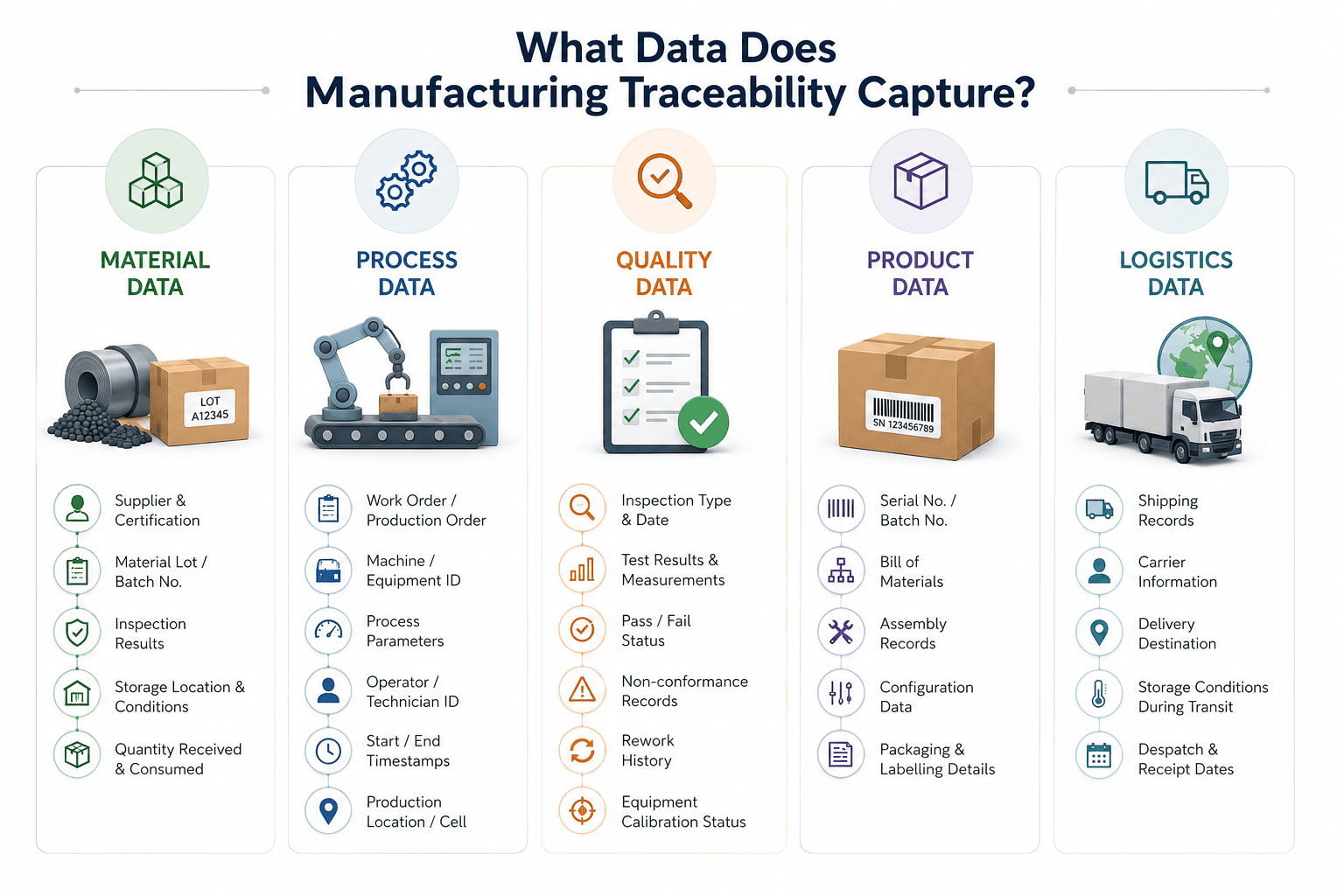
The specific data captured depends on the industry, product type, and regulatory requirements. In general, manufacturing traceability systems capture information across five main categories.
- Material data: Supplier name and certification, raw material lot or batch number, material specification and grade, incoming inspection results, storage location and conditions, quantity received and consumed.
- Process data: Work order and production order references, machine or equipment ID, process parameters (temperature, pressure, speed, cycle time), operator or technician ID, start and end timestamps, production location or cell.
- Quality data: Inspection type and date, test results and measurements, pass or fail status, non-conformance records, rework history, calibration status of measurement equipment.
- Product data: Finished goods serial number or batch number, bill of materials linkage, assembly records, configuration data, packaging and labelling details.
- Logistics data: Shipping records, carrier information, delivery destination, storage conditions during transit, date of despatch and receipt.
6 Examples of Manufacturing Traceability Across Different Industries
While the principles of traceability are similar across industries, implementation varies based on product complexity, regulatory requirements, safety risks, and customer expectations.
The following examples show how traceability is applied across different manufacturing environments:
1. Pharmaceutical and Medical Devices
Traceability is a regulatory requirement in pharmaceutical manufacturing. Manufacturers must maintain batch records documenting every material, process step, and quality test involved in production. For medical devices, Unique Device Identification (UDI) systems assign identifiers that trace each device throughout its production history. In Malaysia, the Medical Device Authority (MDA) requires traceability documentation for registered medical devices.
2. Food and Beverage

Food traceability helps manufacturers manage contamination risks and conduct targeted recalls. Businesses must be able to trace ingredients from their source through to the finished product and identify which customers, distributors, or retailers received affected batches.
As a result, a traceability system for food manufacturing is often an essential part of food safety and compliance programmes. Traceability is also a core component of HACCP-based food safety software.
3. Automotive
Automotive manufacturers rely on component-level traceability across complex global supply chains. Parts are typically linked to their supplier, production date, and material certifications. In the event of a recall, manufacturers must be able to identify every vehicle containing the affected component. Traceability is also embedded within quality standards such as IATF 16949.
4. Aerospace and Defence
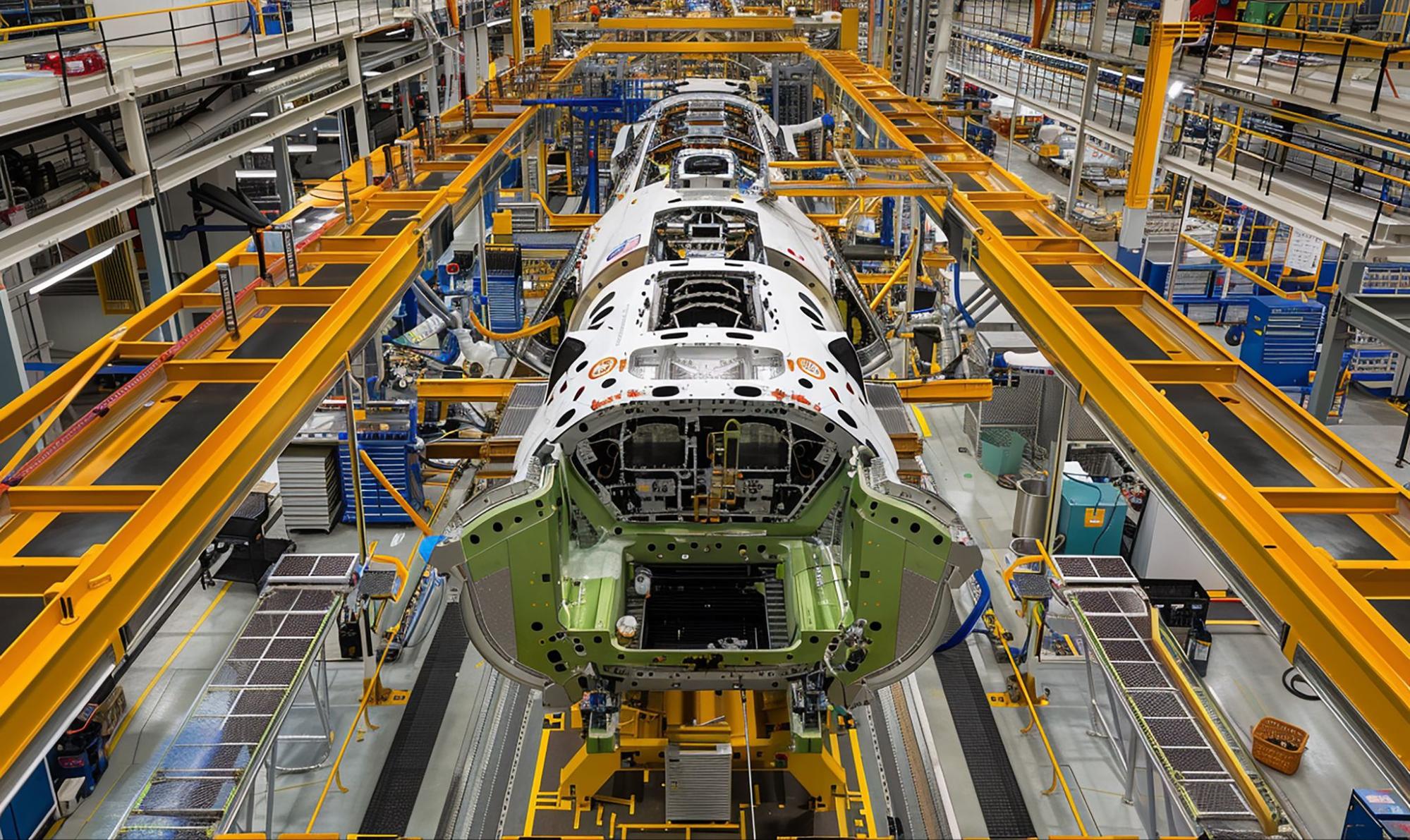
Aerospace components often require lifetime traceability, with records maintained for the entire service life of an aircraft or system. Material certifications, production records, inspection results, and maintenance history must all be linked to specific serial numbers. Given the safety implications of component failure, comprehensive traceability is essential.
5. Electronics
Electronics manufacturers use traceability to track components, printed circuit boards, semiconductors, and finished devices throughout production. This supports warranty management, product liability investigations, counterfeit prevention, and compliance with regulations governing the sourcing of conflict minerals.
6. Petrochemical and Industrial Manufacturing

Industries operating in high-pressure, high-temperature, or hazardous environments require strict material traceability. Manufacturers must maintain records proving that the correct material grades, certifications, and specifications were used in equipment such as pressure vessels, pipelines, and structural components.
Manual vs Digital Traceability Systems
Manufacturers can implement traceability using manual, semi-digital, or fully digital systems. Each approach differs in terms of cost, accuracy, scalability, and ease of data retrieval:
| Approach | How It Works | Key Limitation |
| Manual | Data is recorded on paper forms, batch records, or spreadsheets. | Prone to errors, missing records, and slow data retrieval. |
| Semi-Digital | Data is recorded manually but stored and reported through digital systems. | Still relies heavily on accurate manual data entry. |
| Digital | Data is captured automatically through scanners, sensors, connected equipment, and traceability software. | Higher initial implementation cost. |
Why Digital Traceability Is Becoming the Standard
As manufacturing becomes more complex and data-driven, digital traceability is becoming essential for maintaining tracking and control. It improves accuracy, enables real-time monitoring of production processes, and provides the searchable records needed for faster investigations, recalls, compliance reporting, and continuous improvement.
How Industry 4.0 Enhances Manufacturing Traceability
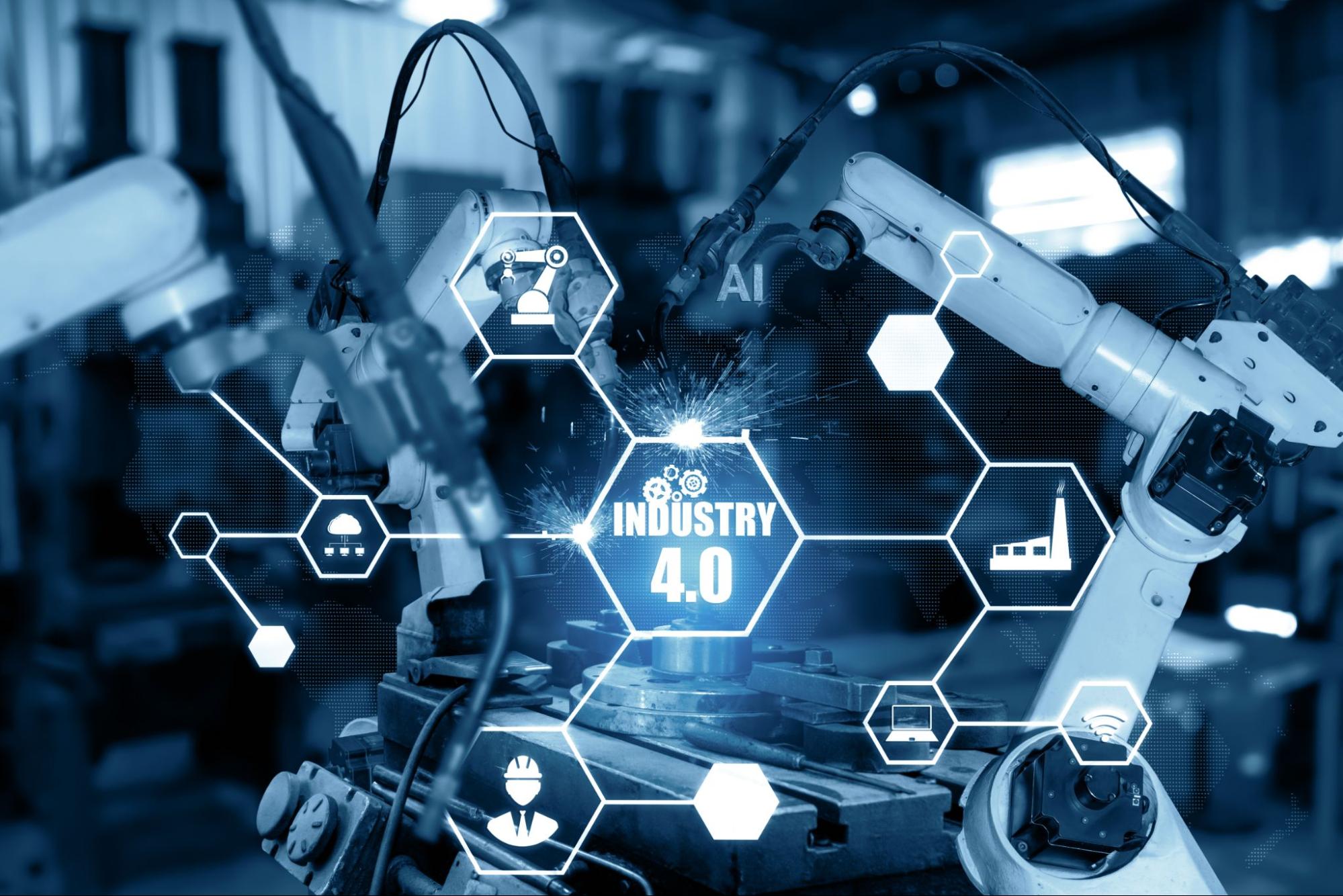
1. Manufacturing Execution Systems (MES)
An MES software serves as the operational backbone of internal traceability. It captures production data such as work orders, process parameters, operator activities, and quality results, linking them to specific products or batches in real time.
2. Enterprise Resource Planning (ERP)
ERP systems connect traceability data with procurement, inventory, sales, and logistics processes. This creates end-to-end tracking, allowing manufacturers to trace products from incoming materials through production and final delivery.
3. IoT Sensors and Connected Equipment
Connected machines and sensors can automatically capture process data such as temperature, pressure, speed, and cycle times. This improves accuracy, reduces manual data entry, and creates a more complete production record.
4. Cloud-Based Platforms
Cloud infrastructure enables traceability data to be accessed and analysed across multiple facilities, suppliers, and locations. This is particularly valuable for manufacturers operating across complex supply chains.
5. Digital Twins
Digital twins create virtual representations of products, equipment, or production processes. When combined with traceability data, they can support process optimisation, predictive quality analysis, and continuous improvement initiatives.
6 Common Challenges in Manufacturing Traceability and How to Overcome Them
While manufacturing traceability offers significant benefits, implementation can be challenging. Understanding the most common obstacles and the best practices for addressing them can help manufacturers improve their chances of a successful deployment:
1. Data Silos
- Production, quality, inventory, and supplier data often reside in separate systems. Without integration, assembling a complete traceability record becomes slow, manual, and prone to errors.
- Best Practice: Integrate existing systems wherever possible. Connecting ERP, MES, and quality systems creates a more complete and reliable traceability record than relying on disconnected tools.
2. Inconsistent Identification Standards
- Different naming conventions for batch numbers, serial numbers, or material codes can make it difficult to connect records across production lines, facilities, or business systems.
- Best Practice: Establish consistent standards for batch numbers, serial numbers, and material codes across the organisation before implementing traceability technology.
3. Implementation Cost and Complexity
- Establishing a traceability system may require investment in software, scanners, labels, sensors, and process changes. For some manufacturers, the upfront cost and operational disruption can be significant.
- Best Practice: Implement traceability in phases, starting with high-risk products or critical processes. Manufacturers may also explore financing and digitalisation programmes that support technology adoption.
4. Operator Adoption
- Traceability depends on accurate and consistent data capture. If employees view traceability processes as burdensome or unnecessary, data quality and system effectiveness can suffer.
- Best Practice: Provide clear training and minimise manual data entry through barcode scanning, automation, or connected equipment wherever possible.
5. Data Volume Management
- Comprehensive traceability generates large amounts of data. Manufacturers need systems capable of storing, managing, and retrieving information efficiently as operations scale.
- Best Practice: Define data retention and storage requirements early, and use scalable platforms that can support future growth.
6. Supply Chain Tracking Gaps
- Even with strong internal traceability, tracking may be limited beyond the factory. Incomplete supplier data can create blind spots that affect product quality, compliance, and recall investigations.
- Best Practice: Require suppliers to provide key traceability information such as batch numbers, certifications, and quality records as part of the procurement process.
Conclusion
For manufacturers in Malaysia, the policy environment is moving in a supportive direction. Programmes such as MIDF’s Future Ready Financing (FRF) provide financing support for SMEs investing in the digital infrastructure that traceability requires. Combined with NIMP 2030‘s goal of developing 3,000 smart factories, the direction is clear: traceability is no longer just a future consideration.
Whether the goal is quality, compliance, or customer confidence, traceability is becoming a business necessity. Contact us today to explore how a custom manufacturing traceability system or ERP solution can support your operational and growth objectives.
Frequently Asked Questions on What is Traceability in Manufacturing
1. What other names is manufacturing traceability known by?
Manufacturing traceability is sometimes referred to as production traceability, lot traceability, or batch traceability, depending on the identification method used.
In supply chain contexts, it may be described as end-to-end traceability or supply chain transparency. In regulated industries, the term “audit trail” is often used to describe the documented record that traceability produces.
2. Should you use batch numbers or serial numbers to support traceability?
It depends on the level of detail required. Batch traceability groups products made under the same conditions, while serial traceability assigns a unique identifier to each item. Many manufacturers use both, applying batch tracking to materials and serial tracking to finished goods.
3. Is it possible to build a traceability system without an MES?
Yes. Traceability can be supported by ERP systems, dedicated traceability software, or even structured spreadsheets. However, an MES provides the most comprehensive support because it captures production data directly from the factory floor in real time.
4. How does manufacturing traceability integrate with ERP and MES systems?
ERP systems manage materials, inventory, procurement, and sales, while MES systems manage production activities. When integrated, they create a complete traceability record covering both supply chain and shop-floor operations.
5. Why is traceability especially critical in regulated industries?
Many regulated industries require traceability to demonstrate compliance, product quality, and process control. Inadequate traceability records can result in regulatory penalties, product licence suspension, or mandatory market withdrawal.
In pharmaceuticals, for example, Good Manufacturing Practice (GMP) regulations require batch records that account for every material, process step, and quality test. In food manufacturing, food safety regulations require the ability to trace an ingredient from its source through to the finished product and point of sale. This is where a traceability system comes into the picture.
6. What is the difference between tracking and traceability?
Tracking shows the current location or status of an item, while traceability provides its complete history, including the materials, processes, and activities involved.
In simple terms, tracking tells you where something is, while traceability tells you how it got there. Both are important in manufacturing, but traceability is particularly valuable for quality control, compliance, and recalls.