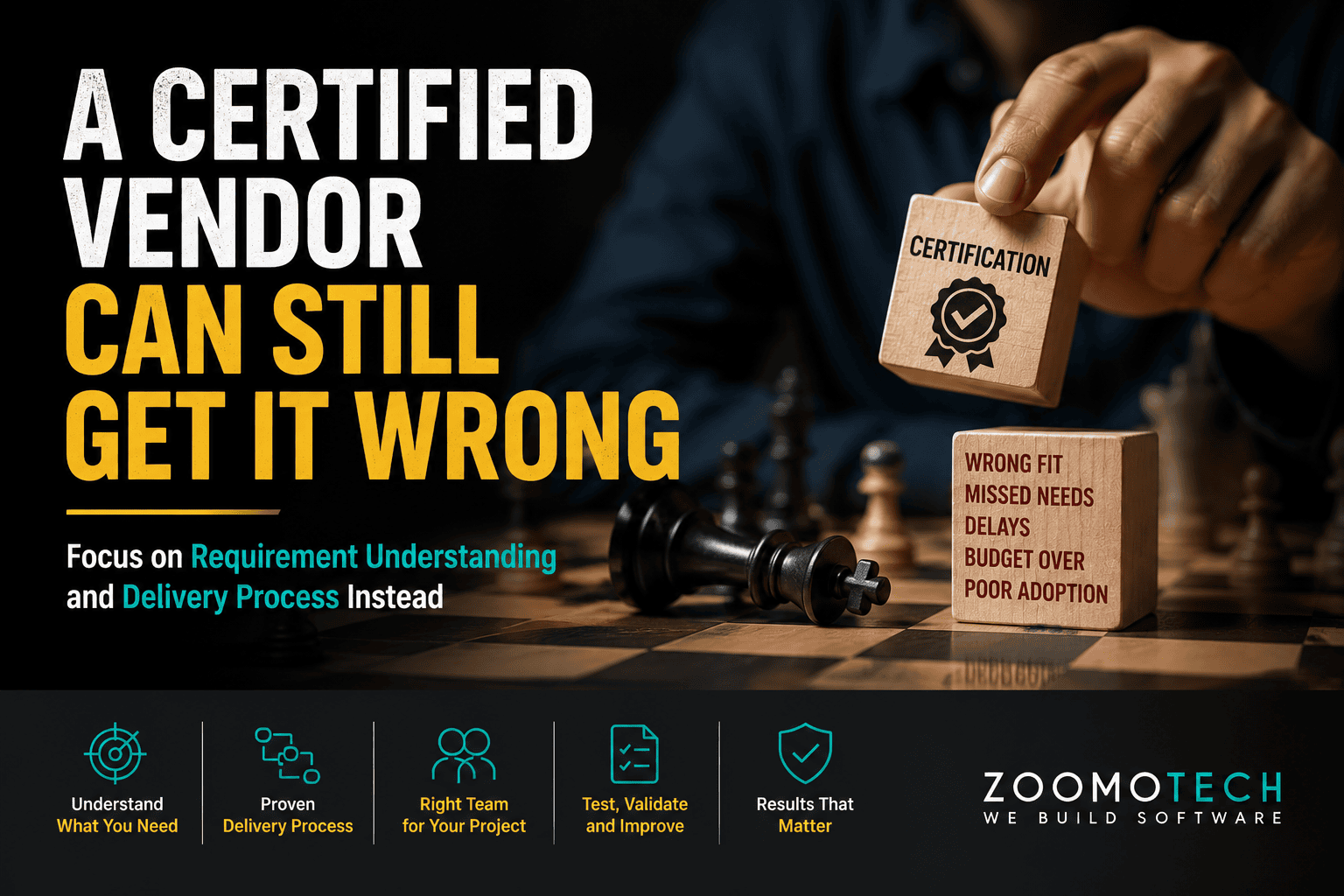
Software Vendor Certification can make a company feel safer when choosing a software vendor. You may have seen this before: a vendor presents a professional company profile, recognised statuses, an experienced team, and a proposal within your expected budget. Everything looks right until someone in top management asks, “What certification does this company have?” Suddenly, confidence can shift even though nothing about the proposed solution has changed.
The concern is understandable. However, a highly certified vendor may still misunderstand your workflow, while a smaller software team can sometimes give closer attention to the actual project. A custom system also differs from a standard product because its outcome depends on how well the vendor understands the business. Certification itself cannot remove every requirement and implementation risk. What matters is whether the vendor can understand your business, manage the project properly, and deliver a system that fits how your company actually operates.
Software Vendor Certification Does Not Equal Delivery Assurance
Software Vendor Certification shows that a company has met defined criteria, but it does not guarantee that a specific custom software project will succeed.
- The assigned team must understand your actual requirements.
- Project execution determines the final outcome.
- Delivery evidence must be assessed separately.
- Certification should be one input, not the final decision.
Certification Is Evidence, Not a Project Guarantee
It is understandable that SME owners use certifications and recognised statuses to reduce uncertainty. They are easy to see, easy to compare, and useful as an initial screening tool. The difficulty is that formal statuses are easier to compare than actual delivery capability.
A custom software project often becomes more complicated once work starts. Requirements become clearer, exceptions appear, users raise different concerns, and project decisions need to be made along the way. A recognised company may still assign people who are not suited to the project. Likewise, a company without recognised certification may still follow strong project discipline. The question is what a recognised status actually tells an SME buyer, and what remains unknown.
What MDEC Digitalisation Partner Status Can and Cannot Prove
An MDEC Digitalisation Partner status (DP status) can provide a practical benefit. For example, it may help an eligible SME access a relevant programme or funding benefit and may make a vendor easier to shortlist. That value should not be dismissed. For an SME comparing similar proposals, a funding benefit can reduce the initial project cost.
However, the status does not automatically show whether the vendor can build your custom system well. It does not prove that the team understands your factory workflow, handles exceptions properly, or can manage implementation issues. Funding benefit and delivery capability are two different questions, and both should be assessed before making a decision.
Software Vendor Certification Does Not Prove Delivery Capability
A company qualification and actual project execution are related, but they are not the same thing. A certificate may show that the company has met certain requirements, yet it does not show how the assigned team will understand your workflow, gather requirements, and handle exceptions once development starts.
It also does not show how users will participate in testing, how changes will be controlled, or how the vendor responds when a problem affects daily operations. This is why previous experience and company qualification should be considered as evidence, not as proof of future project performance. Those details matter because the quality of execution becomes visible during the project, not only during vendor selection.
Understanding Requirements Matters More Than Certification Compliance
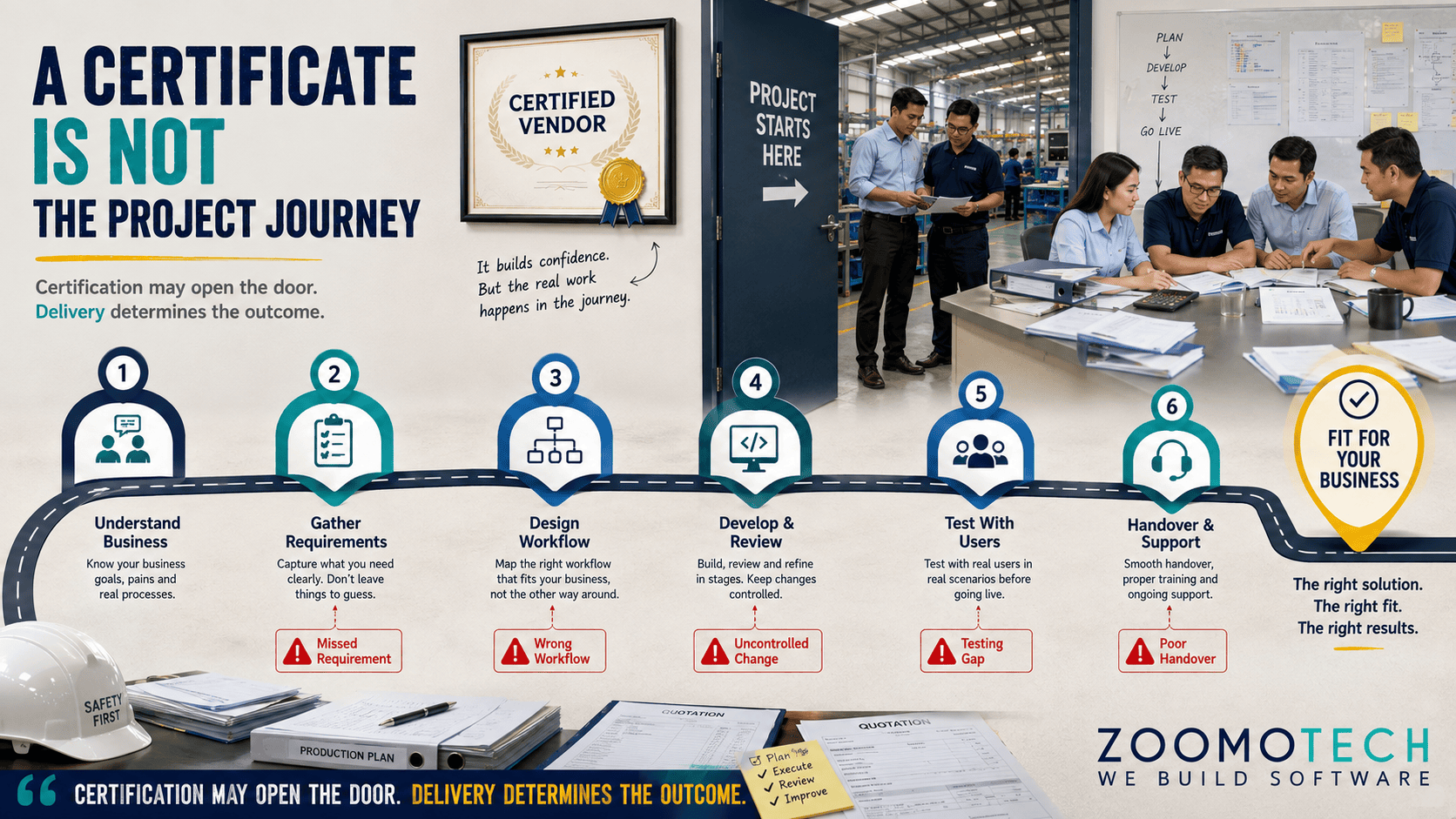
A custom system starts with understanding how the business actually works. Sales, production, purchasing and finance may all describe the same process differently. The normal workflow may look simple, but a special customer request, approval exception, urgent order or last-minute change can alter what the system needs to handle.
This is why requirement discussions matter so much before development begins. Good questions can reveal gaps early, while clear documentation gives both sides a shared reference. Without that understanding, even a capable development team may build something technically sound but unsuitable for daily operations, especially when requirements become more complicated as different departments get involved.
Testing and Handover Reveal More Than Certifications
A system that can be demonstrated is not necessarily a system that your staff can use confidently every day. Real users often discover gaps when they test actual orders, production cases, approvals or reporting situations. These issues may never appear during a polished sales demonstration.
Testing and handover therefore provide useful evidence of how the vendor works. User Acceptance Testing (UAT) can expose practical gaps, while proper documentation helps users understand what has been delivered. A structured handover also affects future support. What happens after launch can tell you whether the vendor remains accountable once the sales discussion is over.
Small SME Projects Need Appropriate Attention and Ownership
A highly certified vendor may have strong capabilities, but that does not automatically mean your project will receive the level of attention you expect. Larger vendors may also be serving much bigger customers, where project resources and management attention may be spread across several priorities.
For an SME, the more useful question is often: “Who will remain accountable for my project?” Project importance should be judged by your business impact, not only the contract value. Clear ownership also matters because requirements will continue to develop. Project governance and clear stakeholder responsibilities help ensure that important decisions have an accountable owner throughout delivery. Recognised status can strengthen a vendor’s profile, but the assigned people still need to stay engaged, make decisions promptly, and remain accountable throughout delivery.
Certification Still Has Value When the Risk Fits
Certification still deserves consideration because it can reduce certain forms of business risk. For some SMEs, it may support procurement requirements, funding eligibility, internal governance or vendor screening. Certain regulated industries may also need formal certified before a vendor can even be considered. The key issue is whether that certificate addresses a meaningful risk in your particular project.
From management’s perspective, the question is therefore not whether certification is good or bad. It is whether the certification reduces a risk that matters to your business. A grant benefit may reduce project cost. An industry certification may satisfy a compliance requirement. But neither should replace assessment of the people, process and delivery approach behind the system, particularly because unclear requirements and implementation decisions can create wider project risks. That is where certification becomes one part of a wider business decision.
Compare Delivery Evidence Before Comparing Vendor Badges
A safer approach is to seek clarity before commitment. Start by understanding how the vendor will study your workflow, who will make project decisions, how changes and exceptions will be controlled, and how testing and sign-off will work. A phased approach also allows both sides to identify risks earlier, before more money is committed. Certification can then be considered as an additional factor, not the only measure of confidence.
Choose the Vendor That Can Prove How It Delivers
Certifications can tell you part of a vendor’s story, but they cannot tell you everything about how your project will be handled. A successful custom software project requires business understanding, technical ability and clear delivery responsibilities. Your assessment should therefore focus on evidence that relates to your actual business risks. Software Vendor Certification can support that judgement, but it should not replace it. Confidence grows when expectations, responsibilities and risks are clear before commitment.
Still unsure after comparing several vendors? You can have a private, no-obligation discussion with me through WhatsApp or Email. We can first look at your current workflow, concerns and project risks, without assuming that custom software is necessarily the answer. A simple conversation may be enough to give you a clearer view before making any commitment.
—
Ning
Founder, Zoomo Tech