Monday morning resignation letter. The operations executive managing production schedules suddenly leaves. Orders still arrive, suppliers still call, but nobody fully understands the daily workflow. This situation reflects a common Key Staff Resignation Risk in many Malaysian SMEs, where operational knowledge gradually concentrates inside one experienced employee.
Understanding Key Staff Resignation Risk in SMEs
Key Staff Resignation Risk arises when daily operations rely heavily on individual staff experience instead of documented workflows or structured systems.
- Critical knowledge sits inside experienced employees
- Limited documentation disrupts operations after resignation
- Business Continuity Planning prepares for staff transitions
- Structured workflows reduce dependency on individuals
Growth Often Increases Dependency on Key Individuals
Growth quietly changes how work is managed. When a company expands from 15 to 60 staff, daily operations become more complex. Production planning, purchasing coordination, and reporting start involving more steps and exceptions. Experienced employees naturally take control of these areas because they understand the details better than anyone else.
Over time, small shortcuts replace formal documentation. Staff remember procedures instead of writing them down. Management still receives reports, but the deeper operational logic sits inside a few individuals. This is why institutional knowledge gradually forms around people rather than structured processes.
Operational Knowledge Is Rarely Written Down
Operational knowledge often lives in experience. Many long-serving employees understand situations that written procedures never fully capture. They know which supplier can rush an order, which machine usually delays production, and how certain customers react when schedules shift. These decisions rarely appear inside formal documents.
Over time, daily operations evolve through habit and personal judgement. Small adjustments accumulate quietly, but documentation rarely updates at the same pace. When this happens, the real workflow exists in people’s routines rather than in a shared reference for the company.
Reporting Remains Stable Until Disruption Happens
Management reports often look normal, which is why many owners only discover deeper operational issues later when Excel management reports hide real business problems. Production numbers, sales figures, and monthly summaries still reach management on time. From the outside, operations look stable because experienced staff quietly correct small issues before they reach the reporting level.
However, these corrections hide deeper operational gaps. Staff compensate for missing steps, undocumented decisions, or unclear responsibilities. The business continues running because someone knows how to fix the problem. The underlying risk stays invisible until the person managing those fixes suddenly leaves.
Replacing Experience Is Harder Than Replacing Staff
Hiring a replacement rarely restores knowledge. A new employee can fill the position on the organisation chart, but rebuilding years of operational understanding takes far longer. Much of that experience involves context rather than instructions.
For example, a purchasing executive may understand which supplier accepts last-minute adjustments or which production sequence prevents delays. These details rarely appear in manuals. When a new staff joins, they must rediscover those relationships and decisions, often through trial and error.
Managers Begin Relying on Informal Communication
Informal coordination gradually increases. When knowledge gaps appear, managers naturally turn to quick solutions. WhatsApp messages, phone calls, and verbal instructions start replacing structured workflows.
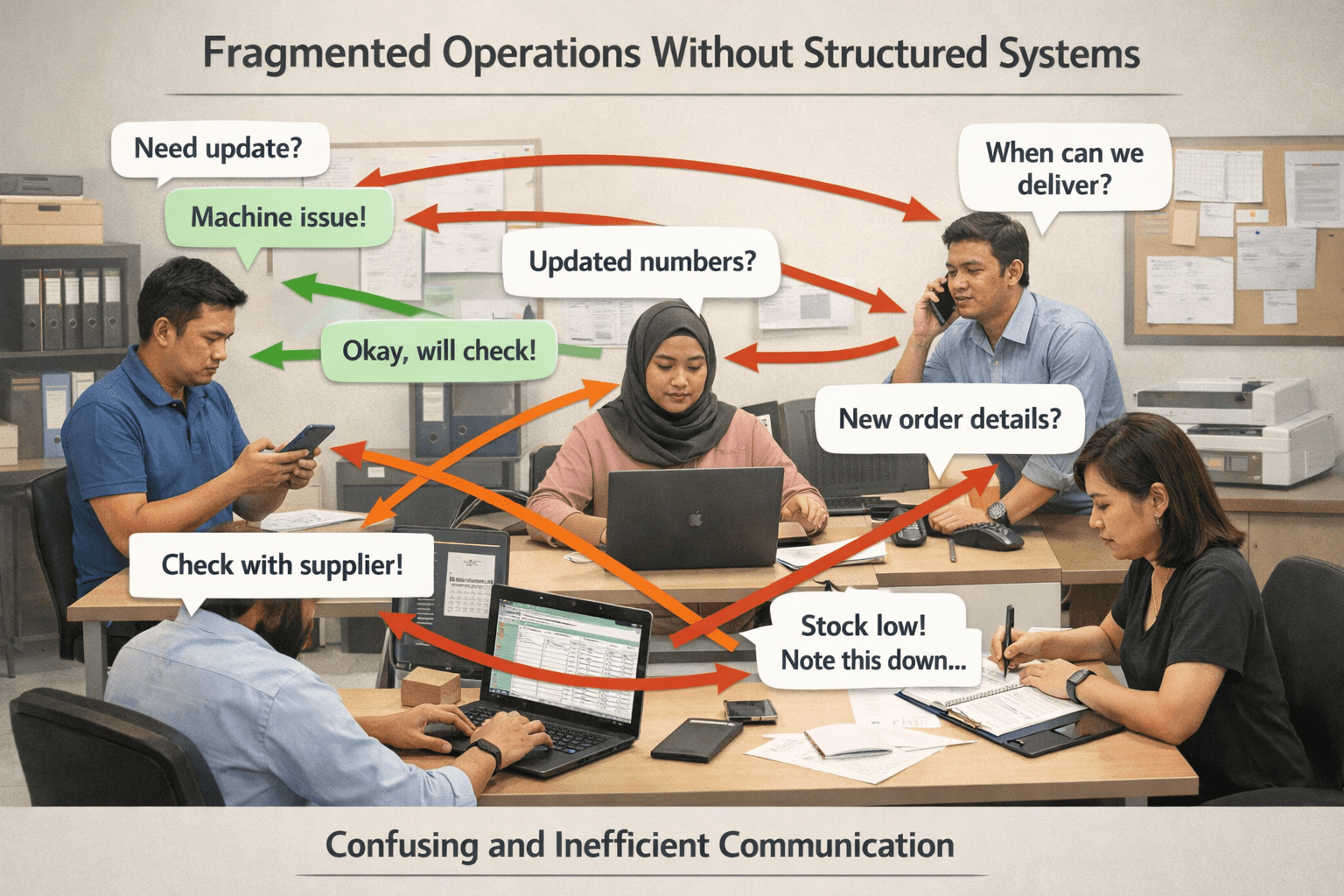
While this approach solves immediate problems, it weakens traceability. Important decisions happen inside chat threads instead of documented processes, a situation similar to what many manufacturers experience when Excel for Manufacturing starts causing daily chaos. Over time, operational visibility declines because information spreads across conversations rather than remaining inside a structured system.
Business Continuity Planning Reduces Staff Dependency Risk
Reducing staff dependency requires deliberate structure. Companies must first identify roles where operational knowledge concentrates heavily in one individual. These roles usually control production planning, purchasing coordination, or critical reporting processes.
From there, teams can map the decision logic behind daily workflows. Documenting the operational steps helps make knowledge visible. Over time, businesses strengthen stability by embedding these processes into shared tools and a computer systems, a direction many SMEs begin exploring through custom software development for operational workflows to support practical Business Continuity Planning across departments.
Leadership Control Weakens When Knowledge Is Concentrated
Control quietly shifts away from leadership. When critical operational knowledge sits with a few individuals, owners and directors find it harder to verify decisions. Reports may still arrive, but the reasoning behind daily operational choices becomes difficult to see or challenge.
Strategic planning also becomes less reliable. If one planner understands production constraints or supplier behaviour better than anyone else, the company’s stability starts depending on that individual. Risk exposure increases gradually, not through dramatic failure but through reduced visibility. Over time, the business relies more on personal experience than on shared organisational knowledge.
Transfer Knowledge From Individuals to Structured Processes
Operational stability begins with visibility. Instead of relying on individual memory, businesses gradually document workflows and decision logic. The goal is not sudden system changes but clearer processes that everyone can understand. With clarity before commitment, companies can strengthen Business Continuity Planning step by step while keeping operational risk under control.
Sustainable Businesses Are Built on Transferable Processes
Businesses should outlast individual employees. When operational knowledge sits inside people rather than processes, stability becomes fragile. Over time, companies that document workflows and reinforce them through shared systems preserve knowledge beyond staff turnover. This approach strengthens Business Continuity Planning and gradually reduces Key Staff Resignation Risk, allowing leadership to maintain clearer oversight as the organisation grows.
If this situation feels familiar in your company, it may be worth reviewing where operational knowledge currently sits. If you are considering how to reduce staff dependency or improve workflow clarity, you are welcome to reach out for a short discussion via WhatsApp or Email. There is no obligation to proceed with anything, sometimes a 15-minute conversation is enough to clarify the next step.
—
Ning
Founder, Zoomo Tech