Inventory is the backbone of any product-based business. Knowing what stock you have, where it is, and when to replenish it is essential for keeping operations running smoothly. As businesses grow and inventory volumes increase, maintaining accurate stock records and tracking across operations can become increasingly challenging.
An Inventory Management System provides the tools needed to track, organise, and control inventory more effectively. This guide explains what an inventory management system is, how it works, the different types available, and the key factors to consider when selecting the right solution.
What is Inventory?
Before diving into systems, it helps to understand what inventory actually means in a business context.
Inventory refers to all the goods and materials a business holds for resale, production, or use in delivering a service. This includes:
- Raw materials: Inputs used in manufacturing (e.g., fabric, steel, chemicals)
- Work-in-progress (WIP): Items partially through the production process
- Finished goods: Products ready for sale or delivery
- MRO supplies: Maintenance, repair, and operations materials that support production without becoming part of the final product
Inventory is both an asset and a liability. Having too little stock can result in missed sales and operational disruptions, while holding too much can lead to wasted resources. Maintaining the right balance is essential for efficient operations and healthy cash flow.
What is an Inventory Management System?
An Inventory Management System (IMS) is software or a structured process that helps businesses track, control, and optimise inventory throughout the supply chain, from procurement to order fulfilment.
At its core, an IMS helps businesses answer three key questions:
- What stock do we have?
- Where is it located?
- When should we reorder it?
Modern inventory management systems do much more than track stock quantities. They bring together purchasing, warehousing, sales, and finance into a single platform, giving businesses clear tracking over inventory levels and movements in real time.
As inventory volumes grow, manual methods become harder to manage accurately and efficiently. Studies have highlighted the value of inventory management systems in providing real-time inventory tracking, leading to improved stock accuracy, operational efficiency, and inventory control.
Benefits of an Inventory Management System
Implementing a well-configured IMS delivers measurable improvements across operations, finance, and customer experience.
Operational Benefits
- Real-time stock tracking across all locations and channels
- Automated reorder triggers that eliminate manual monitoring
- Fewer picking and packing errors
- Faster order processing and fulfilment cycles
Financial Benefits
- Reduced carrying costs from excess inventory
- Lower risk of stock write-offs due to spoilage or obsolescence
- Better cash flow management through leaner stock levels
- More accurate cost-of-goods-sold (COGS) reporting
Customer Experience Benefits
- Fewer out of stocks and backorders
- More accurate delivery timelines
- Improved order accuracy
Strategic Benefits
- Data-driven demand forecasting
- Supplier performance tracking
- Scalability without proportional increases in headcount
How Does an Inventory Management System Work?
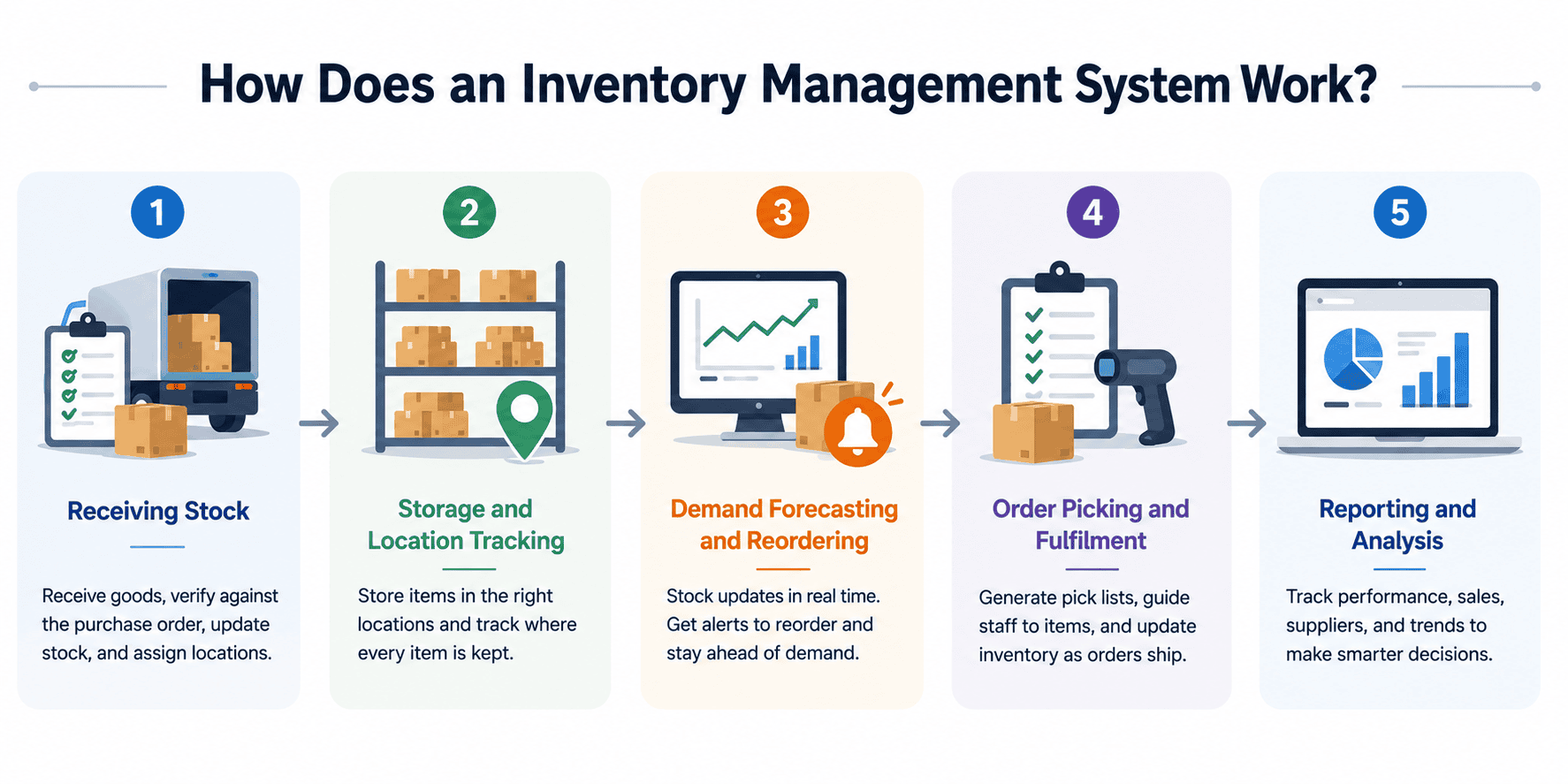
1. Receiving Stock
When goods arrive from a supplier, the inventory management system records the delivery, verifies it against the original purchase order, updates stock quantities, and assigns storage locations. Any discrepancies, such as missing or excess items, can be identified immediately.
2. Storage and Location Tracking
Items are stored in designated shelves, bins, or warehouse zones. The system tracks where each item is located, making stock retrieval, inventory checks, and audits more efficient. It can also help businesses organise storage space by placing frequently ordered items in more accessible locations.
3. Demand Forecasting and Reordering
As inventory is sold or used, stock levels are updated automatically. When stock starts running low, the system can alert staff to reorder products. Tracking sales trends and inventory levels also helps businesses keep enough stock on hand without ordering more than they need.
4. Order Picking and Fulfilment
When an order is received, the system generates a picking list and guides staff to the required items. Many systems can streamline the picking process by grouping orders together, helping staff fulfil orders more efficiently while keeping inventory records up to date.
5. Reporting and Analysis
Inventory management systems continuously collect data on stock movement, sales performance, supplier reliability, and demand trends. These insights help businesses improve forecasting, optimise purchasing decisions, identify slow-moving inventory, and maintain healthier stock levels over time.
Types of Inventory Management
Inventory isn’t one-size-fits-all. Depending on where a product sits in your supply chain, it falls into one of these categories:
| Type | Description | E-commerce Example | Key Challenge |
| Raw Materials | Unprocessed inputs used to create products | Fabric for a print-on-demand clothing store | Supplier delays can halt all production |
| Work-in-Progress (WIP) | Partially finished goods still in production | Custom-engraved items awaiting completion before dispatch | Ties up capital; hard to sell if orders change |
| Finished Goods | Completed products ready for sale | Packaged skincare products sitting in a fulfillment warehouse | Overstocking leads to dead stock; understocking loses sales |
| Packing Materials | Supplies used for packaging products | Boxes, bubble wrap, branded tape, poly mailers | Easy to overlook until you run out mid-peak season |
| MRO (Maintenance, Repair, Operations) | Items needed to keep equipment and operations running | Printer ink, label rolls, barcode scanner batteries | Often untracked until failure causes downtime |
Methods of Inventory Management
This section covers how inventory management is carried out. No single method works for every business. The right approach depends on your industry, supplier reliability, and how predictable your demand is. These are the most widely used techniques:
| Method | Key Principle | Best For | Pros | Cons |
| JIT (Just-in-Time) | Receive goods only when needed | Sellers with reliable, fast suppliers | Cuts holding costs; reduces dead stock risk | Vulnerable to supplier delays or demand spikes |
| EOQ (Economic Order Quantity) | Calculate optimal order quantity to minimise total costs | Businesses with stable, predictable demand | Balances order and holding costs mathematically | Assumes constant demand; breaks down with seasonality |
| ABC Analysis | Categorise inventory by value/importance (A=high, B=medium, C=low) | Stores with large, varied SKU (unique products) catalogs | Focuses attention and budget where it matters most | Requires regular recategorisation as sales shift |
| FIFO (First-In, First-Out) | Sell the oldest inventory first | Perishable goods, fashion, anything trend-sensitive | Prevents spoilage and obsolescence; keeps inventory valuation closer to current market costs | Requires organised storage and clear labeling |
| MRP (Materials Requirement Planning) | Plan material orders based on production schedules | Manufacturers with complex, multi-component products | Reduces material shortages and production delays | Complex to set up; requires accurate demand forecasts |
| Cycle Counting | Regularly count small inventory subsets instead of a full stocktake | Any business wanting ongoing accuracy | Less disruptive than full counts; catches errors early | Requires discipline and consistent scheduling |
| Batch Tracking | Track items by production batch or lot number | Products with quality control or recall risk | Enables fast, targeted recalls; improves traceability | Adds complexity to receiving and picking processes |
| Vendor-Managed Inventory (VMI) | Suppliers monitor inventory levels and manage replenishment on behalf of the business | Businesses with stable supplier relationships and predictable demand | Lower inventory costs; less administrative work | Less control over replenishment decisions; requires data sharing and strong supplier coordination |
Examples of Inventory Management Systems
Inventory management solutions range from simple tools to enterprise-grade platforms. Here is how they break down by type:
1. Basic Standalone IMS
Dedicated inventory software with core tracking, reorder alerts, and basic reporting.
Best for: Small businesses managing a single location
2. Automated / Cloud-Based IMS
Cloud-hosted platforms with real-time syncing, barcode scanning, multichannel support, and integrations with e-commerce platforms.
Best for: Growing businesses with multiple channels or locations
3. Warehouse Management Systems (WMS)
Focused specifically on warehouse operations, such as bin locations, pick paths, receiving, and packing workflows. Often integrated with or part of a broader IMS.
Best for: Businesses with significant warehousing operations
4. Third-Party Logistics (3PL) Systems
When a business outsources fulfilment to a 3PL provider, it typically uses its provider’s IMS portal to monitor stock and orders remotely.
Best for: E-commerce businesses using outsourced fulfilment
5. Enterprise Resource Planning (ERP)
Business platforms that combine inventory management, finance, HR, CRM, and other functions into a single ERP system.
Best for: Large enterprises requiring integrated business-wide tracking
10 Key Features of an Inventory Management System
When evaluating an IMS, look for these core capabilities:
- Real-time inventory tracking: Live stock counts across all locations, updated automatically with every transaction.
- Barcode and RFID scanning: Physical scanning to eliminate manual data entry errors at receiving, picking, and dispatch.
- Reorder point automation: Automatic alerts or purchase orders triggered when stock falls below defined thresholds.
- Demand forecasting: Analysis of historical sales data, seasonality, and trends to predict future stock needs.
- Multi-location management: Tracking across multiple warehouses, stores, or fulfilment centres from a single dashboard.
- Batch and serial number tracking: Essential for food, pharmaceuticals, and electronics, where specific production batches or individual unit serial numbers are tracked.
- Supplier management: Centralised records of supplier pricing, lead times, and performance history.
- Integrations: Connections to e-commerce platforms (Shopify, WooCommerce), accounting software (Xero, QuickBooks), and shipping carriers.
- Reporting and analytics: Customisable reports on stock turnover, shrinkage, carrying costs, and fulfilment performance.
- Growth readiness: Scales with your business where increasing SKUs (unique products), locations, order volumes, and users are handled without requiring a system switch
How to Choose an Effective Inventory Management System
1. Define Your Requirements First
- How many SKUs do you manage?
- How many locations or sales channels do you operate across?
- Do you manufacture, distribute, or retail?
- What integrations do you need (accounting, e-commerce, 3PL)?
2. Key Questions to Ask Vendors
- Does it support your inventory management method?
- Can it scale as you grow without a full system migration?
- What does implementation and onboarding look like?
- How is customer support structured (local, 24/7, ticketed only)?
3. Best Practices for Implementation
- Conduct a full stock count before going live, and do not import inaccurate data
- Train all staff on receiving, picking, and adjustment workflows
- Set reorder points based on actual lead times and safety stock requirements
- Review and adjust reorder points quarterly as demand patterns change
- Run a parallel period (old and new system together) before fully switching over
While off-the-shelf inventory systems work well for many businesses, some may require custom features, workflows, or integrations. Zoomo Tech develops custom inventory management software tailored to specific operational needs and business requirements.
Red Flags and Common Challenges
Even well-implemented systems can run into problems. Watch out for:
- Poor data quality: Inaccurate stock counts or outdated supplier information can lead to unreliable inventory records from the start.
- Low user adoption: If staff are not properly trained or do not consistently use the system, inventory accuracy can quickly decline.
- Outdated settings: Reorder points and stock thresholds should be reviewed regularly to reflect changing demand and business needs.
- Integration issues: Systems that do not connect with accounting software, e-commerce platforms, or logistics providers can create unnecessary manual work.
- Vendor lock-in: Some platforms make it difficult to export data or switch providers, limiting flexibility in the future.
- Limited scalability: A system that meets current requirements may struggle as inventory volumes, product ranges, or business operations expand.
The Future of Inventory Management
Inventory management systems are evolving beyond basic stock tracking. Modern platforms increasingly incorporate automation, data analytics, and intelligent forecasting to help businesses make faster and more informed decisions.
1. Artificial Intelligence (AI)
AI-powered inventory management systems can analyse sales trends, predict future demand, and identify unusual inventory activity, helping businesses optimise stock levels and reduce costly errors.
2. Internet of Things (IoT)
Connected devices and smart sensors provide real-time inventory monitoring. From warehouse shelving to delivery vehicles, IoT technology helps businesses track inventory more accurately with less manual intervention.
3. Blockchain Technology
Blockchain improves inventory traceability by creating secure, transparent records of inventory movements. This is particularly valuable for industries that require strict compliance and product verification.
4. Sustainability Initiatives
As businesses place greater emphasis on sustainability, inventory management is playing a key role in reducing waste, improving returns management, and supporting more efficient use of resources throughout the supply chain.
Conclusion
An inventory management system helps businesses maintain accurate stock levels, improve operational efficiency, and make better purchasing decisions. From small businesses managing a growing product range to larger organisations operating across multiple locations, the right system can provide greater tracking and control over inventory.
As inventory requirements become more complex, having a solution that aligns with your business processes becomes increasingly important. Zoomo Tech is a custom software company that develops tailored inventory management solutions for businesses of all sizes. Contact us to discuss your requirements and explore the best approach for your business.
Frequently Asked Questions (FAQs) on What is an Inventory Management System
1. What is the difference between inventory and stock?
Stock usually refers to finished products ready for sale, while inventory is a broader term that includes raw materials, work-in-progress items, and finished goods. In retail, the terms are often used interchangeably.
2. What is the difference between a SKU and a UPC?
A SKU (Stock Keeping Unit) is an internal product identifier created by a business for inventory tracking. A UPC (Universal Product Code) is a standardised barcode assigned by the manufacturer and used across retail supply chains. A product can have both a SKU and a UPC.
3. What is the difference between periodic and perpetual inventory systems?
A periodic inventory system updates stock levels through scheduled stock counts, while a perpetual inventory system updates inventory in real time as transactions occur. Most modern inventory management systems use the perpetual approach for greater accuracy and tracking.
4. What is the difference between inventory management and inventory optimisation?
Inventory management focuses on tracking and controlling stock. Inventory optimisation uses forecasting and analytics to determine the ideal stock levels, reorder points, and purchasing strategies. In simple terms, management maintains inventory, while optimisation improves it.
5. When should I upgrade my inventory management system?
It may be time to upgrade if you frequently experience stock discrepancies, order fulfilment issues, excessive manual processes, or difficulties managing multiple sales channels and locations. If your team spends more time working around the system than using it, an upgrade is likely worth considering.
6. How much does an inventory management system cost in Malaysia?
Inventory management system costs in Malaysia vary depending on business size and requirements:
- Basic systems: Typically RM130–RM200/month
- Systems for growing businesses: Typically RM330–RM1,550/month
- Enterprise solutions: Typically RM4,500+/month
- Custom systems: Typically from RM15,000+, depending on features and integrations
As pricing varies between providers, it is best to discuss your requirements directly with vendors for an accurate quotation.