
Malaysia’s manufacturing sector is embracing Industry 4.0 to improve efficiency, tracking, and productivity. By connecting machines, production processes, and business systems, manufacturers can make faster, more informed decisions. Two key technologies supporting this transformation are Enterprise Resource Planning (ERP) and Manufacturing Execution Systems (MES).
The importance of these systems has grown as manufacturers face ongoing supply chain disruptions, from material shortages and shipping delays to rising costs and changing demand. ERP and MES help businesses gain better tracking and respond more quickly to operational challenges, but they serve different purposes. If you’re unsure whether your business needs an ERP, an MES, or both, this article will help clarify the differences and trade-offs.
What is an ERP System?

An Enterprise Resource Planning (ERP) system is a centralised software platform that integrates core business functions such as finance, HR, procurement, inventory, and operations into a single system. This creates a shared source of information across the organisation and reduces the need for disconnected tools.
Think of an ERP as the command centre for your business. It gives management a way to track the key activities, from inventory and orders to financial performance and workforce planning. For manufacturers, ERP systems often include MRP capabilities to support production and inventory planning.
Key Features of an ERP System
ERP systems vary significantly between vendors, industries, and deployment models, so the exact features available will depend on the platform you choose. However, most modern ERP systems include the following core capabilities:
| ERP Feature | What It Does |
| Financial Management | Tracks accounts payable and receivable, general ledger, budgeting, and financial reporting across the entire business. |
| Supply Chain Management | Manages supplier relationships, logistics, and high-level movement of goods. |
| Procurement & Purchasing | Automates purchase orders, manages quotes (RFQs), and handles invoice matching. |
| Human Resources | Handles payroll, employee records, leave management, and performance tracking. |
| Sales and Order Management | Processes customer orders, manages pricing, and tracks fulfilment from quote to delivery. |
| Inventory and Warehouse Management | Provides tracking over stock levels, locations, and reorder triggers across multiple sites. |
| Production Planning (MRP module) | Generates material requirements and production schedules based on demand forecasts and inventory. |
| Project Management | Tracks project tasks, resource scheduling, budgets, and milestone-based billing. |
| Service Management | Manages post-sale support, field service scheduling, repairs, and warranty tracking. |
| Reporting and Analytics | Consolidates data from all departments into dashboards and executive-level reports. |
| Compliance & Risk | Ensures regulatory compliance, maintains secure audit trails, and automates tax localisation. |
| CRM Integration | Links customer data with order history, support tickets, and sales pipeline management. |
Benefits of an ERP System
- Unified data: Reduces duplication and eliminates information silos across departments.
- Improved financial tracking: Supports better decision-making at the leadership level.
- Streamlined procurement and inventory management: Reduces excess stock and carrying costs.
- Faster order fulfilment: Improves coordination between sales, production, and logistics.
- Scalability: Allows the system to grow with the business by adding modules as needed.
- Compliance and audit readiness: Centralises financial and operational records for easier tracking and reporting.
What is an MES System?

A Manufacturing Execution System (MES) is a software platform that monitors, tracks, and controls manufacturing activities on the shop floor in real time. Unlike an ERP, which focuses on business-wide planning and management, an MES is directly connected to production processes, machines, and operators.
Think of an MES as the operational layer of your factory. It translates production plans into shop-floor activities, tracks progress as work is completed, and provides real-time data on production performance, quality, and machine utilisation.
Key Features of an MES System
| MES Feature | What It Does |
| Work Order Management | Dispatches, tracks, and closes work orders in real time, ensuring each production task is assigned and completed on schedule. |
| Real-Time Data Collection | Automatically gathers machine, sensor, and operator data as production happens, with no manual input required. |
| Production Scheduling and Sequencing | Manages the order and timing of jobs on the shop floor, optimising machine use and minimising idle time. |
| Quality Management | Performs in-line quality checks and flags non-conformances immediately, reducing defects and rework costs. |
| Resource and Labour Tracking | Monitors personnel deployment, machine status, and material availability to prevent bottlenecks. |
| Traceability | Records the complete history of each unit, linking raw materials, specific processes, and sub-assemblies to the final product. |
| Maintenance Management | Schedules preventive and predictive maintenance, reducing unplanned downtime. |
| Alarm and Event Management | Issues real-time alerts when production deviates from plan, enabling rapid corrective action. |
| Document Control | Delivers digital SOPs, blueprints, and compliance documents directly to operators’ screens based on the live job. |
| Performance Analysis (OEE) | Consolidates real-time data to calculate Overall Equipment Effectiveness, analysing machine availability, speed, and quality output. |
Benefits of an MES System
- Real-time tracking: Provides insight into production progress, machine status, and output rates.
- Reduced defect rates: Supports continuous in-process quality monitoring and control.
- Lower production costs: Helps identify bottlenecks, downtime patterns, and waste early.
- Full product traceability: Tracks products from raw materials to finished goods, supporting compliance and audits.
- Faster response to disruptions: Uses automated alerts and escalation workflows to address issues quickly.
- Better machine utilisation: Supports predictive and preventive maintenance scheduling to minimise downtime.
The Industrial Automation Pyramid
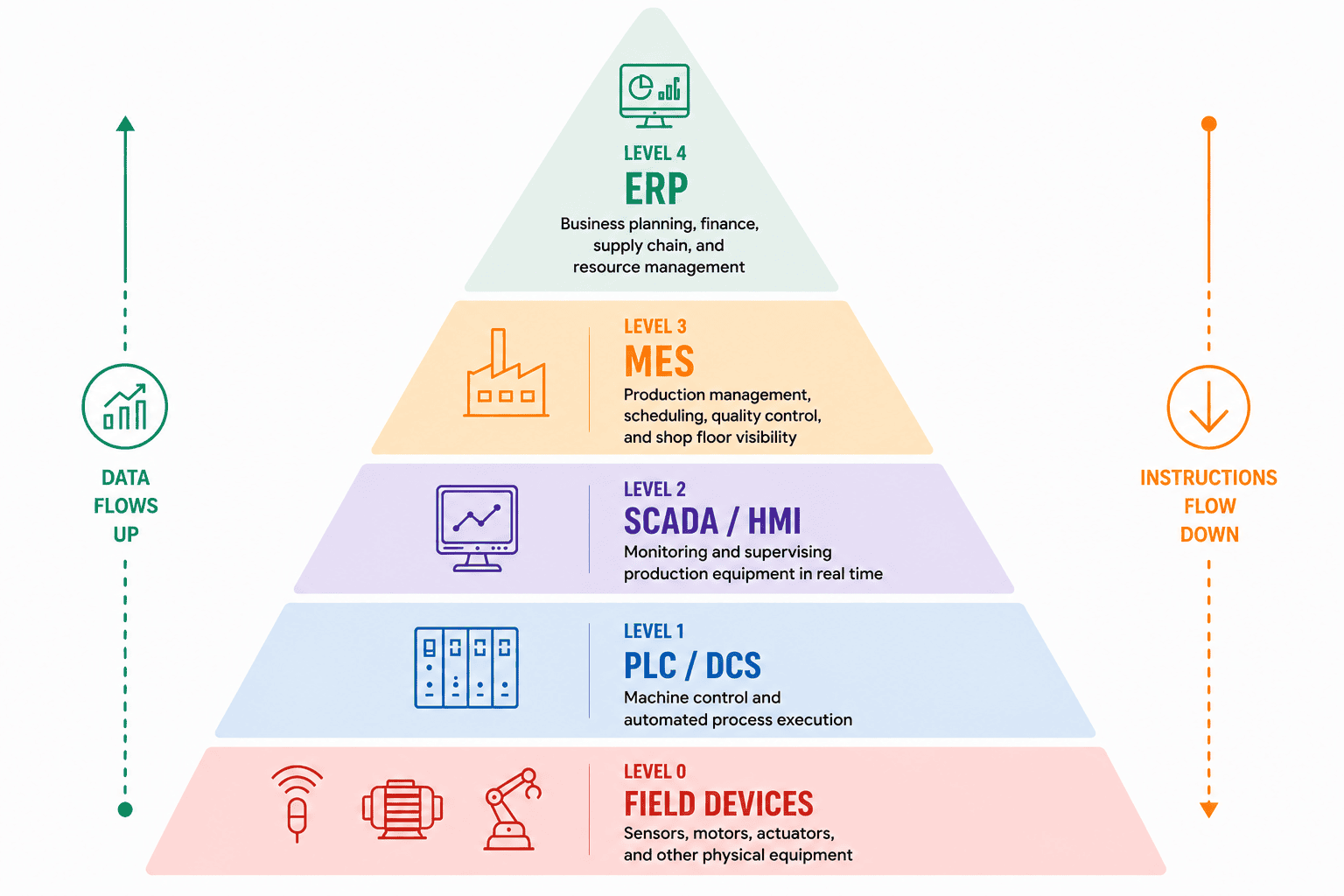
The industrial automation pyramid is made up of multiple layers, each responsible for a different aspect of manufacturing operations and business management.
- Level 4 (ERP): Business planning, finance, supply chain, and resource management. Data primarily flows downward through planning, schedules, and resource allocation.
- Level 3 (MES): Production management, scheduling, quality control, and shop floor tracking. Data flows in both directions between business systems and production operations.
- Level 2 (SCADA / HMI): Monitoring and supervising production equipment in real time. Data flows in both directions to provide tracking and control.
- Level 1 (PLC / DCS): Machine control and automated process execution. Data flows in both directions between control systems and equipment.
- Level 0 (Field Devices): Sensors, motors, actuators, and other physical equipment. Data primarily flows upward from the factory floor to higher-level systems.
When these layers are connected, information can flow seamlessly between the factory floor and business systems, giving manufacturers greater tracking, faster decision-making, and better operational control.
6 Key Aspects of ERP vs MES Systems
1. Functionality
ERP: ERP systems are designed to manage business-wide operations, including finance, HR, procurement, inventory, and supply chain management. They provide a central view of the organisation and help departments work from the same set of data.
MES: MES systems focus specifically on manufacturing operations. They monitor production activities, track work orders, manage quality processes, and provide a tracking method for what is happening on the shop floor in real time.
Example: An ERP may record that 500 units were produced today. An MES can identify which machine produced each unit, who operated it, and whether it passed quality checks.
2. Data Capture and Tracking
ERP: ERP systems typically rely on user input, scheduled updates, or data transferred from other systems. This makes them well-suited for business planning, reporting, and long-term decision-making.
MES: MES systems collect data continuously from machines, sensors, and operators. This real-time tracking allows manufacturers to detect problems as they happen rather than after production has already been completed.
Example: An ERP may receive production data at the end of a shift, while an MES can immediately flag a quality issue or machine fault.
3. Triggering Actions
ERP: ERP systems trigger business-level processes such as generating purchase orders, updating inventory records, creating invoices, or allocating materials for future production.
MES: MES systems trigger operational responses on the factory floor. These can include maintenance alerts, quality notifications, machine stoppages, or workflow escalations when production conditions change.
Example: When stock falls below a predefined threshold, an ERP can automatically create a purchase order. When a machine overheats, an MES can instantly notify maintenance personnel.
4. System Integrations
ERP: ERP systems integrate horizontally across the organisation, connecting departments such as finance, HR, procurement, sales, and logistics within a single business platform.
MES: MES systems integrate vertically throughout the production environment. They connect with machines, sensors, PLCs, and SCADA systems while exchanging production data with the ERP.
5. Implementation Timeline
ERP: ERP implementations are usually larger projects because they affect multiple departments and business processes. Configuration, data migration, user training, and change management can extend deployment timelines.
MES: MES implementations are generally faster because they focus on manufacturing operations rather than the entire organisation. However, complexity can increase when multiple production lines or specialised equipment are involved.
6. Cost of Implementation
ERP: ERP systems generally require a larger investment due to their broader scope and organisation-wide deployment. However, affordable custom ERP options are available for Malaysian SMEs, making ERP more accessible than many businesses assume.
MES: MES systems are often less expensive than full ERP implementations, though complex factories with extensive integration and customisation requirements may see costs comparable to ERP.
Summary of Differences between ERP and MES
To summarise, ERP and MES systems operate at different levels of the manufacturing process. The table below highlights their key differences at a glance:
| Aspect | ERP | MES |
| Primary Purpose | Manages business-wide operations and planning | Manages and monitors production activities on the shop floor |
| Focus Area | Finance, procurement, inventory, HR, sales, and supply chain | Production, quality, traceability, machine performance, and labour tracking |
| Users | Management, finance, HR, procurement, sales, and operations teams | Production managers, supervisors, operators, and quality teams |
| Data Source | User input, business transactions, and scheduled updates | Real-time data from machines, sensors, and operators |
| Tracking | Business-wide tracking across departments | Real-time tracking into manufacturing operations |
| Planning vs Execution | Focuses on planning and resource allocation | Focuses on production execution and control |
| Response Time | Supports strategic and operational decision-making | Supports immediate operational responses |
| Integrations | Connects business functions across the organisation | Connects production equipment and shop floor systems |
| Typical Outputs | Purchase orders, invoices, inventory plans, financial reports | Production records, quality data, downtime reports, OEE metrics |
| Implementation Scope | Organisation-wide | Manufacturing-focused |
| Typical Timeline | 6–18 months or more | 3–9 months |
| Cost | Generally higher due to broader scope, though affordable custom ERP options are available for SMEs | Often lower, but can be comparable to ERP in highly complex production environments |
Conclusion
The ERP vs MES system debate is not about determining which solution is better. While an ERP handles the “why” and “when” of business planning, an MES focuses on the “how” of executing those plans on the factory floor. For many manufacturers, the most effective approach is not choosing one over the other, but using both together.
As a custom application development company, we specialise in building tailored ERP and MES solutions for manufacturers. Ready to modernise your operations? Partner with us to build the right ERP or MES solution for your business.
Frequently Asked Questions about ERP vs MES System
1. If I already have an ERP system, do I also need an MES?
It depends on your manufacturing processes and operational requirements. For manufacturers with straightforward production workflows, an ERP with MRP capabilities may be sufficient. However, businesses that require real-time production tracking, detailed traceability, quality monitoring, or downtime tracking often benefit from adding an MES.
A simple way to think about it: an ERP tells you what should happen, while an MES shows you what is actually happening on the factory floor.
2. How do ERP and MES systems work together?
ERP and MES systems connect business planning with production execution. The ERP creates production plans and work orders, while the MES manages and tracks their execution on the shop floor.
As production progresses, the MES sends real-time data back to the ERP, helping keep inventory records, production schedules, and business decisions accurate and up to date.
3. What is the difference between SCADA, ERP, and MES?
These systems operate at different levels of the industrial automation pyramid.
- SCADA: Monitors and controls machines and equipment in real time.
- MES: Manages production activities, quality, traceability, and shop floor performance.
- ERP: Manages business functions such as planning, procurement, inventory, and finance.
In short, SCADA controls machines, MES manages production, and ERP manages the business.
4. What is the difference between MES and MRP?
MRP (Material Requirements Planning) focuses on planning. It determines what materials are needed, how much is required, and when they should be ordered.
MES focuses on execution. It manages production activities in real time and tracks how work is progressing on the shop floor.
In short, MRP helps prepare for production, while MES helps manage production.
5. Why are MES and ERP systems often confused with one another?
MES and ERP systems are often confused because both support manufacturing operations and share information. However, they serve different purposes. ERP focuses on business planning and resource management, while MES focuses on production execution and real-time shop floor tracking.
Because they are frequently integrated and used together, many people assume they perform the same role when they actually address different parts of the manufacturing process.