One of the first questions businesses ask when considering custom software is simple: How much is this going to cost? The challenge is that the answer can range from RM15,000 for a basic internal tool to RM300,000+ for a fully integrated enterprise platform.
That range can seem surprisingly wide at first. After all, both projects are technically “software.” The difference comes down to what the system needs to do. A simple dashboard or booking tool requires far less planning and development than a platform that connects multiple departments, integrates with external systems, and supports compliance requirements.
This guide breaks down software development pricing in Malaysia for 2026, covering typical cost ranges, what businesses can expect at different budget levels, the key factors that influence pricing, and practical tips for budgeting a custom software project with confidence.
Why Businesses Choose Malaysia for Custom Software Development
Malaysia has quietly become one of the most competitive destinations for software development in Asia. Several factors explain why local businesses build here and why international companies increasingly outsource here:
- Cost relative to quality: Malaysian development rates are generally lower than those in Singapore, Australia, and the UK, while still providing access to skilled technical talent.
- Growing technology ecosystem: Government support for digitalisation, AI, and Industry 4.0 continues to strengthen Malaysia’s technology sector. This creates a larger pool of skilled talent, greater innovation capacity, and a more mature ecosystem for businesses investing in custom software development.
- Strong English proficiency: Clear communication helps reduce misunderstandings, project delays, and costly revisions.
- Local integration expertise: Malaysian software teams are familiar with MyInvois, PDPA compliance, FPX, DuitNow, AutoCount, SQL Account, and other commonly used local systems.
Why Malaysian Businesses Are Building Custom Software

- Unique workflows: Businesses often have operational requirements that standard software cannot accommodate effectively. Custom solutions are built around existing processes instead of forcing teams to adapt to rigid workflows.
- Disconnected systems: Many organisations rely on separate tools for sales, inventory, accounting, and operations. Custom software can integrate these systems or consolidate them into a single platform, improving visibility and reducing duplicate work.
- Local compliance requirements: Regulations such as MyInvois e-invoicing, PDPA compliance, and industry-specific reporting requirements often require functionality beyond what off-the-shelf solutions provide.
- Automation and efficiency: Manual tasks that consume valuable staff time can be automated, reducing errors and allowing teams to focus on higher-value work.
- Scalability: As businesses grow, their software needs become more complex. Custom platforms can evolve alongside the organisation, supporting new processes, users, and operational requirements without requiring a complete system replacement.
So, How Much Does Custom Software Development Cost in Malaysia?
The table below reflects typical Malaysian market rates based on project complexity:
| Project Type | Estimated Cost (RM) | Typical Timeline | Examples |
| Discovery & Validation Phase | Free (1–3 days) for projects under RM300,000; RM5,000 – RM20,000 for large ERP projects above RM300,000 | 1–3 days (projects under RM300,000); 5–20 days (large ERP projects) | Interactive prototype, technical feasibility assessment |
| Basic Application or MVP (Minimum Viable Product) | Up to RM20,000 | 1–2 months | Internal management dashboard, appointment booking platform, straightforward CRUD (Create, Read, Update, and Delete) application |
| Business Management Solution | RM30,000 – RM80,000 | 2–4 months | Customer relationship management system, inventory management software, e-commerce solution |
| Advanced Operational Platform | RM100,000 – RM200,000 (can reach RM500,000 for large ERP projects) | 4–12 months (depending on the scope) | Enterprise resource planning system, multi-tenant SaaS product, custom logistics management platform |
| Enterprise-Grade System with Regulatory Requirements | RM300,000 – RM1,000,000+ | 6–24 months (depending on the scope) | Fintech platform requiring regulatory compliance, healthcare software with PDPA controls, regional or multi-country deployment |
To better understand what drives these price ranges, we’ll break down each project category in more detail in the next section.
Features Typically Included at Each Price Level
1. RM15,000 – RM50,000 (Simple tool or MVP)
Typically includes:
- A single workflow or department-focused solution
- Basic user management and admin interface
- Standard CRUD functionality (create, read, update, delete records)
- Limited third-party integrations
- Basic reporting and dashboards
- Suitable for validating a business idea or digitising a manual process
At this level, systems are usually standalone, with little or no data sharing across departments.
2. RM50,000 – RM150,000 (Mid-range business software)
Typically includes:
- Multiple connected modules
- Department-to-department data sharing
- Structured user roles and permissions
- Workflow automation and approval processes
- Integration with selected external systems
- More advanced reporting and management dashboards
At this level, the software becomes a core operational tool rather than a standalone application.
- RM150,000 – RM300,000 (Complex operational system)
3. RM150,000 – RM300,000 (Complex operational system)
Typically includes:
- End-to-end workflows across multiple departments
- Real-time integration between operations, inventory, finance, and production
- Advanced automation and business rules
- Compliance features such as PDPA controls and e-invoicing support
- Detailed reporting, analytics, and audit trails
- Scalability planning for future growth
At this level, the system often replaces significant manual coordination and becomes central to day-to-day operations.
4. RM300,000+ (Enterprise platform)
Typically includes:
- Multi-company, multi-location, or multi-country support
- Deep integration with ERP, accounting, payment, or third-party systems
- Enterprise-grade security and access controls
- Comprehensive audit logging and compliance architecture
- Custom executive reporting and business intelligence
- High availability, performance, and scalability requirements
At this level, software is often considered a strategic business platform rather than simply an operational tool.
Other Types of Custom Software Development
Custom software is not limited to a single format. Depending on your business needs, it can take several forms, each with its own cost structure and technical requirements:
| Type | Typical Cost (RM) | Timeline | Typical Features | Examples |
| Web Software | RM15,000 – 150,000+ | 1–12 months | Browser-based access, user authentication, database management, third-party integrations, reporting dashboards | CRM, inventory management system, e-commerce platform, ERP |
| Mobile Application (iOS/Android) | RM50,000 – RM300,000+ | 1–12 months | Native or cross-platform development, backend web-based admin system, API integration, push notifications, App Store, Google Play, and AppGallery deployment, offline functionality | Delivery tracking app, field sales app, on-demand service platform |
| Game Development | RM30,000 – RM300,000+ | 3–12 months | Game engine integration, interactive UI, physics and animation, multiplayer logic, monetisation systems | Corporate training simulation, educational game, casual mobile game |
| Cloud-Based Software | RM50,000 – RM500,000+ | 3–12 months | Distributed architecture, auto-scaling infrastructure, multi-tenant support, high availability, subscription billing | SaaS platform, multi-branch business management system |
| Embedded Software | RM30,000 – RM200,000+ | 2–8 months | Hardware integration, real-time processing, low-level programming, firmware updates, sensor data management | Factory floor monitoring system, IoT device controller, smart retail kiosk |
| AI and Machine Learning | RM15,000 – 200,000+ | 3–12 months | Predictive modelling, data pipeline setup, model training and deployment, integration with existing systems | Demand forecasting tool, fraud detection system, customer churn prediction |
Of these, mobile applications are increasingly central to how Malaysian businesses reach customers and manage operations. Because they introduce additional cost considerations around platform coverage and backend infrastructure, they are worth examining on their own.
Mobile App Development Costs in Malaysia

Mobile apps follow a similar pricing structure to custom software, but tend to cost more because you are building for at least two platforms (iOS and Android) plus a backend API.
| App Category | Typical Cost (RM) | Development Timeline | Example Applications |
| Basic Mobile Application | RM50,000+ | 1–2 months | Appointment scheduler, business directory, simple utility app |
| Business-Focused Mobile App | RM50,000 – RM120,000 | 2–4 months | Online store, membership platform, parcel tracking app |
| On-Demand Service App | RM100,000 – RM200,000 | 3–5 months | Food delivery platform, ride-booking app, courier service app |
| Enterprise or Medical Application | RM150,000 – RM300,000 | 4–8 months | Telehealth solution, EHR-connected system, workforce management app |
| Advanced Consumer Platform | RM300,000+ | 6–12 months | Social networking app, fintech platform, highly regulated digital service |
What Factors Change the Price of Custom Software in Malaysia?
1. Project Scope
The biggest driver of cost is simply how much the software needs to do.
- A basic login system is relatively inexpensive.
- Features such as payment processing, fraud detection, real-time notifications, and advanced reporting add significant complexity.
- Scope creep is one of the most common reasons projects exceed budget.
- Adding a non-trivial feature mid-project can increase costs by RM8,000–RM25,000 or more.
2. Third-Party Integrations
Connecting to external systems often requires substantial development and testing.
Common integrations include:
- MyInvois (LHDN e-invoicing)
- FPX and GrabPay
- SQL Account and AutoCount
- Existing ERP systems
Each major integration can add RM3,000–RM15,000 to project costs. A MyInvois integration alone often costs RM5,000–RM10,000.
3. UI/UX Design Complexity
The more polished and customer-facing the software, the more design work is required.
- Internal admin systems typically require minimal design.
- Customer portals and mobile apps often require custom user journeys, branding, and interface design.
- Design and UX commonly account for 10%–20% of total project costs.
4. Team Composition
Who builds the software affects pricing.
- Freelancers: RM80–RM200/hour
- Agencies: RM150–RM350/hour
- In-house developers: RM8,000–RM18,000/month per developer, excluding employment costs
Agencies generally cost more but provide project management, QA, continuity, and broader technical expertise.
5. PDPA Compliance Requirements
Systems that handle customer information may require additional compliance features to meet the requirements of Malaysia’s Personal Data Protection Act, particularly following more recent amendments.
Examples include:
- Consent management
- Data retention controls
- Audit logging
- Encryption and security measures
Building these requirements from the start typically adds RM5,000–RM25,000 depending on complexity.
6. Cross-Platform vs. Native Mobile Development
The mobile development approach can significantly affect cost.
- Cross-platform frameworks such as React Native are usually the most cost-effective option.
- Separate native iOS and Android applications typically cost 1.3–1.7× more to build and maintain.
- Native development is generally reserved for apps requiring specialised hardware or platform-specific functionality.
7. Maintenance
Development is a one-time investment, but maintenance is an ongoing expense.
Typical maintenance costs include:
- Infrastructure and cloud hosting
- Software updates and compatibility fixes
- Security patches and bug fixes
As a rule of thumb, annual maintenance costs are usually 15%–20% of the original development budget. For a RM100,000 system, that works out to approximately RM15,000–RM20,000 per year.
Many Malaysian software agencies also offer maintenance retainers starting from RM1,500–RM3,000 per month for small-to-medium business systems.
Common Development Pricing Models
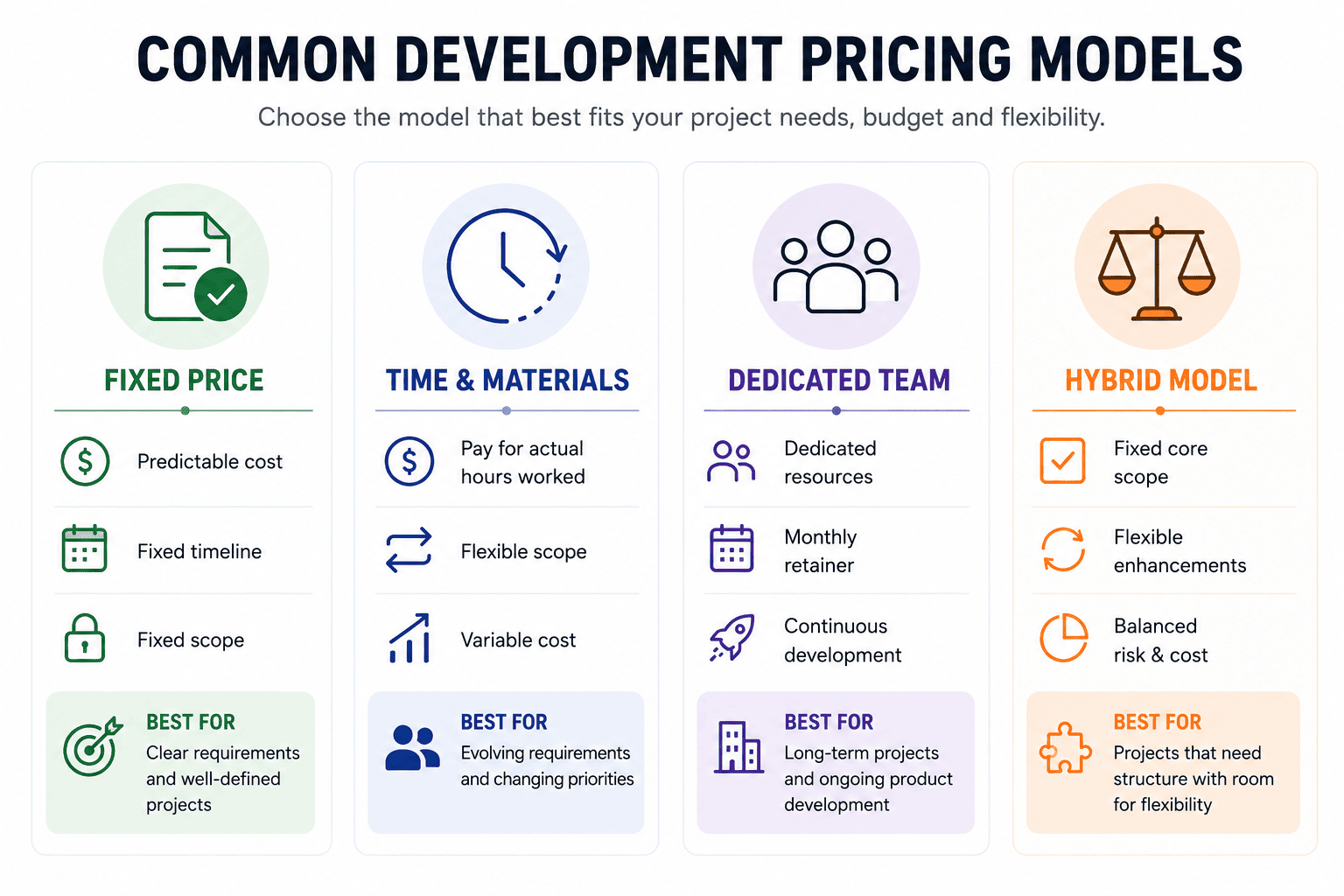
- Fixed Price
1. Fixed Price
- You agree on a fixed cost and timeline before development begins.
- Best suited for projects with well-defined and stable requirements, such as a simple business application, MVP, or e-invoicing integration.
- The vendor carries the delivery risk. If development takes longer than expected, they absorb the additional cost.
- Be aware that significant scope changes during development typically result in change requests and additional charges.
- Time and Materials
2. Time and Materials
- You pay for the actual hours worked, usually at an agreed hourly or daily rate.
- Requirements can evolve throughout the project, allowing features to be added, modified, or removed as needed.
- Best suited for complex projects where requirements are likely to change based on testing, feedback, or business needs.
- The client carries more financial risk because additional development time directly increases project costs.
3. Dedicated Team
- You engage a dedicated team that works exclusively on your product for a recurring monthly fee.
- The team typically includes developers, project managers, designers, and QA specialists.
- Best suited for startups, scale-ups, and enterprises requiring continuous development, frequent feature releases, or long-term product growth.
- Costs are predictable, but value depends on maintaining a clear and consistent development roadmap.
4. Hybrid Model
- Combines a fixed-price engagement for the core scope with time-and-materials billing for enhancements, integrations, or post-launch development.
- Provides budget certainty for the initial build while preserving flexibility for future changes.
- Commonly used for MVPs and business software projects where some requirements are known upfront but others will emerge over time.
How the Quoting Process Usually Works

Most custom software companies in Malaysia follow a similar process once you make contact:
- Initial Discussion: You explain the business problem, workflow, or process you want to improve. A good vendor will ask about users, integrations, compliance requirements, and existing systems before discussing costs.
- Scoping and Discovery: For smaller projects, an indicative quote may be provided after an initial discussion and a written brief. Larger projects often require a paid discovery phase (typically RM5,000–RM15,000) to produce detailed requirements and a more accurate estimate.
- Proposal and Quotation: The vendor provides a proposal outlining the project scope, estimated cost, timeline, milestones, and recommended team structure.
- Review and Negotiation: Pricing, milestones, IP ownership, support terms, and payment schedules are typically discussed and refined before work begins.
- Project Delivery: Once development starts, reputable vendors provide regular progress updates, milestone demonstrations, and clear communication when scope changes affect cost or timelines.
What Should You Get in a Custom Quote?
A quality quote should include more than just a total price. Look for the following:
- Scope Document: A clear description of what will be built, including key features and functionality.
- Milestones and Payment Terms: Defined project stages with payments linked to deliverables rather than full payment upfront.
- Out-of-Scope Items: A list of exclusions to minimise misunderstandings and unexpected charges later.
- Post-Launch Support: Details on warranty periods, bug-fix coverage, and ongoing maintenance or support rates.
- IP Ownership Terms: Confirm that ownership of the software and source code is transferred to your company upon completion to avoid any disputes.
- Relevant Experience: Examples of similar projects, case studies, or references that demonstrate the vendor’s experience in your industry or use case.
Ongoing Costs: What to Budget After Launch
The development quote is only part of the total investment. To avoid surprises, budget for the following ongoing and one-time costs after launch:
1. Maintenance and Support
Software requires ongoing updates to remain secure, compatible, and reliable.
- Annual maintenance typically costs 15%–20% of the original development budget.
- An RM100,000 system generally requires RM15,000–RM20,000 per year for maintenance.
- Costs cover hosting support, bug fixes, security patches, dependency updates, and third-party API changes.
2. Hosting and Infrastructure
Most applications rely on cloud infrastructure such as AWS, Azure, or Google Cloud.
- Typical SME hosting costs range from RM500–RM5,000 per month depending on traffic, storage, and uptime requirements.
3. Third-Party Services
Many systems depend on external services that charge recurring fees.
Examples include:
- Payment gateways
- SMS and email delivery
- Maps and location services
- Analytics and monitoring tools
These costs can range from RM300–RM2,500 per month depending on usage.
4 .Data Migration and Training
Moving data from spreadsheets or legacy systems often requires additional effort that may not be included in the initial quote.
You should also budget for user training and a transition period to ensure staff adoption and minimise operational disruption.
Tips for Maximising Your Software Investment
- Start with an MVP: Build the core functionality first, launch early, gather feedback, and expand based on real user needs.
- Compare Multiple Quotes: Obtain at least three proposals and compare scope clarity, support terms, vendor experience, and communication quality, not just price.
- Use Milestone-Based Delivery: Structure payments around deliverables and project milestones rather than paying the full amount upfront.
- Explore Tax Incentives and Grants: Investigate available grants and tax incentives before signing a development contract. Malaysian companies may be eligible for capital allowances on customised software development costs under the Income Tax (Capital Allowance) (Development Cost for Customised Computer Software) Rules 2024, helping reduce the overall cost of investment
Trends Shaping Custom Software Development in Malaysia

1. AI-Assisted Development
AI tools are helping developers work faster by automating routine coding tasks and testing. While this can reduce development time for some projects, the biggest cost drivers remain planning, architecture, integrations, and compliance requirements.
2. MyInvois Integration Demand
As Malaysia’s e-invoicing rollout continues, more businesses require software that can connect with MyInvois. Systems that handle invoicing, billing, or financial reporting increasingly need this capability built in from the start.
3. Growing Focus on PDPA Compliance
Recent updates to Malaysia’s Personal Data Protection Act have increased the importance of proper data handling. Businesses are placing greater emphasis on features such as consent management, audit trails, and data security controls.
4. Cross-Platform Mobile Development
Frameworks such as React Native have become the preferred approach for many SME mobile projects. They allow businesses to launch on both iOS and Android more quickly and cost-effectively than separate native apps.
Conclusion
As Malaysian businesses continue to digitise their operations, custom software is becoming less about replacing spreadsheets and more about creating systems that accelerate growth.
By understanding the factors that influence pricing, budgeting for ongoing costs, and choosing the right development approach, businesses can make more informed decisions and achieve stronger long-term returns. If you are exploring a custom software project and would like guidance tailored to your requirements, contact us today to discuss your goals and receive a personalised estimate.
Frequently Asked Questions about the Costs of Custom Software Development in Malaysia
1. How long does custom software development usually take in Malaysia?
Timelines depend on project complexity. A simple MVP or internal tool can often be completed in 4 to 8 weeks, while a business application with integrations and user roles typically takes 3 to 5 months. Larger enterprise platforms involving compliance requirements may take 6 to 12 months or more. Discovery, design, testing, and user acceptance testing are often the biggest factors affecting timelines.
2. Should I hire a Malaysian agency or a freelancer for custom software?
Freelancers can be a cost-effective option for smaller projects with clear requirements. For more complex systems, agencies typically offer stronger project management, broader technical expertise, ongoing support, and quality assurance.
3. How much should I budget for software maintenance each year?
A common benchmark is 15% to 20% of the initial development cost annually. For example, an RM80,000 project may require RM12,000 to RM16,000 per year for hosting, security updates, bug fixes, and system upgrades. Regular maintenance helps prevent larger repair costs and security risks later.
4. Is custom software cheaper than SaaS?
SaaS (Software as a Service), also known as subscription-based software, is usually more affordable in the short term, while custom software can deliver better value over time for businesses with specialised processes, multiple integrations, or growing subscription costs.