
Everything looks stable on the report. Many Malaysian SMEs review monthly Excel Management Reports showing steady numbers, yet operations suddenly face delays, stock shortages, or customer complaints. Owners often wonder how problems appeared overnight. In reality, early warning signs were already present — just hidden quietly inside the reporting structure.
How Excel Management Reports Create Visibility Gaps
Excel Management Reports often hide early operational problems because information is manually summarised before reaching management:
- Operational signals disappear during data aggregation
- Manual Business Reporting depends on staff judgement
- Important context removed to simplify reports
- Management sees snapshots, not real operations
Excel Was Designed for Analysis Not Operational Reporting
Excel was never designed for operational reporting. It works very well for personal analysis, financial calculations, or preparing individual reports. Many Malaysian SMEs started this way — one department using spreadsheets to analyse numbers or prepare simple summaries for management.
Over time, however, Excel slowly becomes a cross-department reporting tool — a common situation discussed in When Excel for Manufacturing Starts Causing Daily Chaos. Production, purchasing, sales, and inventory all submit their own files. As workflows grow more complex, spreadsheets struggle to reflect daily operations. Reporting begins to depend on manual consolidation and interpretation, setting the stage for problems hidden inside summary tables.
Production Issues Often Disappear Inside Summary Tables
Small operational signals often vanish early. In many SMEs, detailed production updates are reduced into monthly or weekly summaries before reaching management. When numbers are aggregated into totals or averages, delays in specific work orders or production lines become much harder to notice.
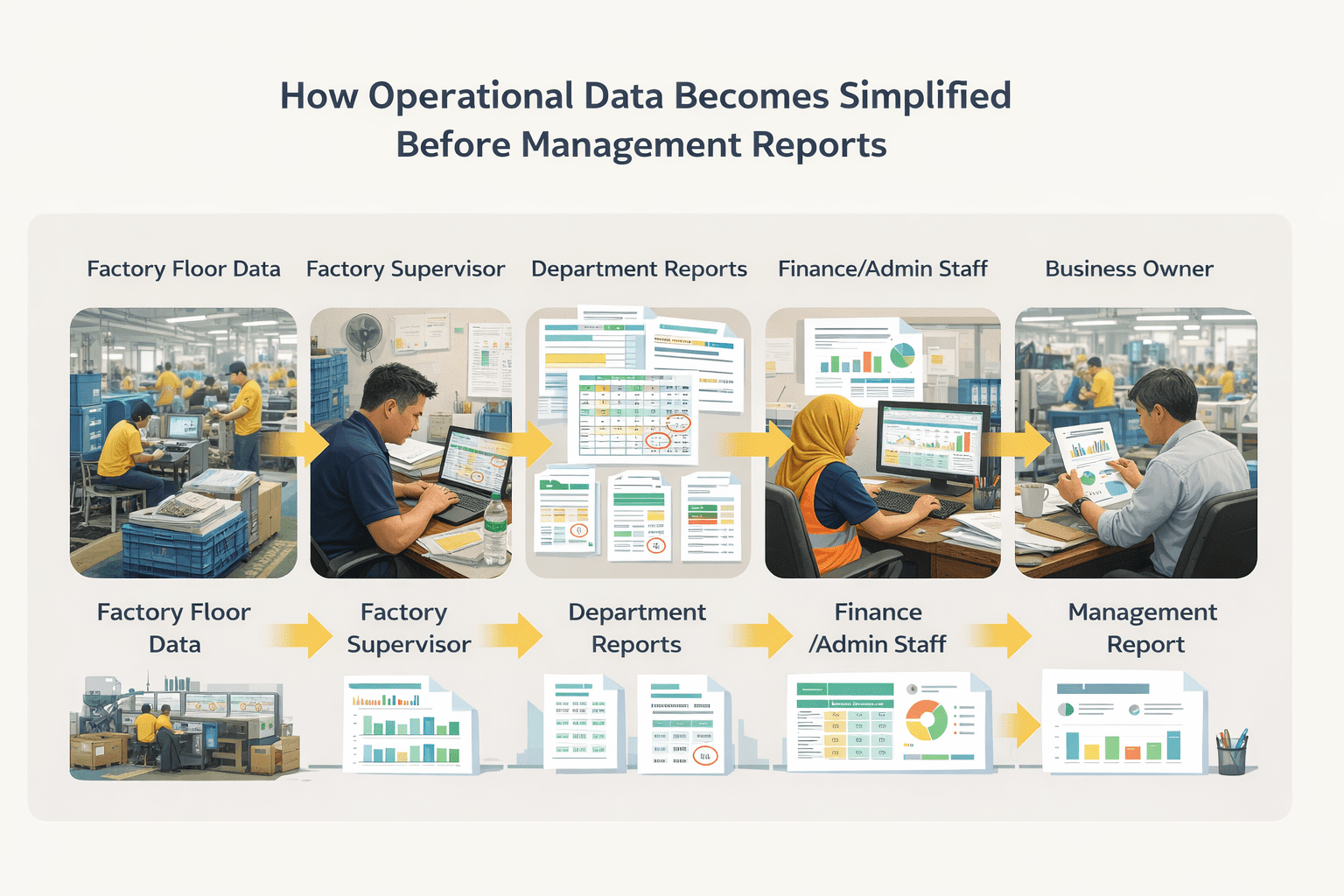
For example, a factory report may show overall output meeting targets, yet certain machines or shifts are consistently behind schedule. These patterns are difficult to detect inside spreadsheets because Excel focuses on totals rather than workflow behaviour, which is one reason many manufacturers begin exploring Manufacturing Execution Systems to improve production visibility. As a result, early warning signals are diluted, and managers only realise the problem when delays accumulate across multiple orders.
Manual Business Reporting Relies on Staff Interpretation
Reports are often shaped by human judgement. In many companies, staff prepare management reports by selecting what information should be included. While this is usually done with good intentions, it introduces interpretation into the reporting process.
Different departments may view performance metrics differently. A production supervisor might highlight output numbers, while a logistics team focuses on delivery schedules. During summarisation, context is often lost, especially when complex operational details are simplified into a few figures. Over time, reporting accuracy becomes dependent on individual understanding rather than structured workflow data, which is why some companies begin evaluating custom software development to structure internal workflows.
Simplified Reports Gradually Reduce Management Awareness
Reports are designed to be easy to read. Management reports are usually simplified so that leaders can review them quickly during meetings. Tables are cleaned up, exceptions removed, and numbers summarised to present a clear overview.
However, simplification has a hidden trade-off. When complexity is removed for readability, important operational details disappear as well. Management sees the outcome of operations, such as total production or monthly sales, but not the underlying causes. Over time, visibility into day-to-day operations quietly decreases, even though the reports themselves appear well organised.
Reporting Processes Become Harder to Audit Over Time
Spreadsheets accumulate hidden complexity. As reporting processes evolve, Excel files often grow larger and more complicated. New formulas are added, sheets are duplicated, and manual adjustments are made to align numbers between departments.
After several years, it becomes difficult to trace where certain figures originate. A number in the final report may pass through multiple spreadsheets before reaching management. When discrepancies appear, tracking the source can take hours or even days. In many SMEs, this gradual complexity makes reporting processes increasingly difficult to audit or verify.
Operational Bottlenecks Surface Only After Customer Pressure
Many operational issues surface late. Because reporting cycles are periodic, problems often remain hidden until they affect customers. A production delay may only become visible when a delivery date is missed or when a customer follows up on an order.
Inventory mismatches can also remain unnoticed until warehouse staff begin searching for stock that should already exist. At this stage, management is forced to react rather than prevent the issue earlier. The longer reporting delays persist, the more operational stress spreads across departments trying to resolve the problem quickly.
Growth Without Visibility Increases Strategic Risk
Growth quietly increases operational complexity, which is why many established SMEs eventually begin evaluating ERP systems designed for manufacturing operations. As companies expand, more departments, suppliers, and production activities become involved in daily operations. Yet many SMEs still depend on periodic spreadsheets or Excel Management Reports to understand what is happening. These reports summarise historical numbers but rarely reflect real-time operational conditions.
When management decisions rely on delayed or incomplete information, planning becomes fragile. Production capacity, inventory levels, and delivery commitments may appear stable on paper while underlying issues continue to build. Over time, leaders are forced to make strategic decisions using partial visibility, increasing the risk of missed opportunities, operational disruption, or unexpected financial exposure.
Operational Visibility Should Precede Management Reporting
Operational visibility should come first. When workflow systems capture activities directly from production, purchasing, or logistics, reporting becomes a natural outcome rather than a manual exercise. The practical approach is simple: start with clarity, observe where signals are lost, and improve visibility step by step. Risk is reduced when understanding comes before system changes.
The First Step Is Understanding Where Visibility Is Lost
Operational problems rarely appear suddenly. In most SMEs, the signals were already present but hidden inside reporting layers. When companies rely heavily on Excel Management Reports, management often sees structured summaries instead of operational behaviour. The practical step is not immediately replacing systems, but first identifying where visibility disappears between departments. Once leaders understand where reporting compresses reality, decisions become clearer and improvements can be planned with far lower risk.
If this situation feels familiar in your company, a quiet conversation may help clarify the next step. Many SME owners simply want a second perspective on whether their current reporting structure still reflects real operations. You may reach out privately via WhatsApp or email if you prefer a practical discussion without obligation.
—
Ning
Founder, Zoomo Tech