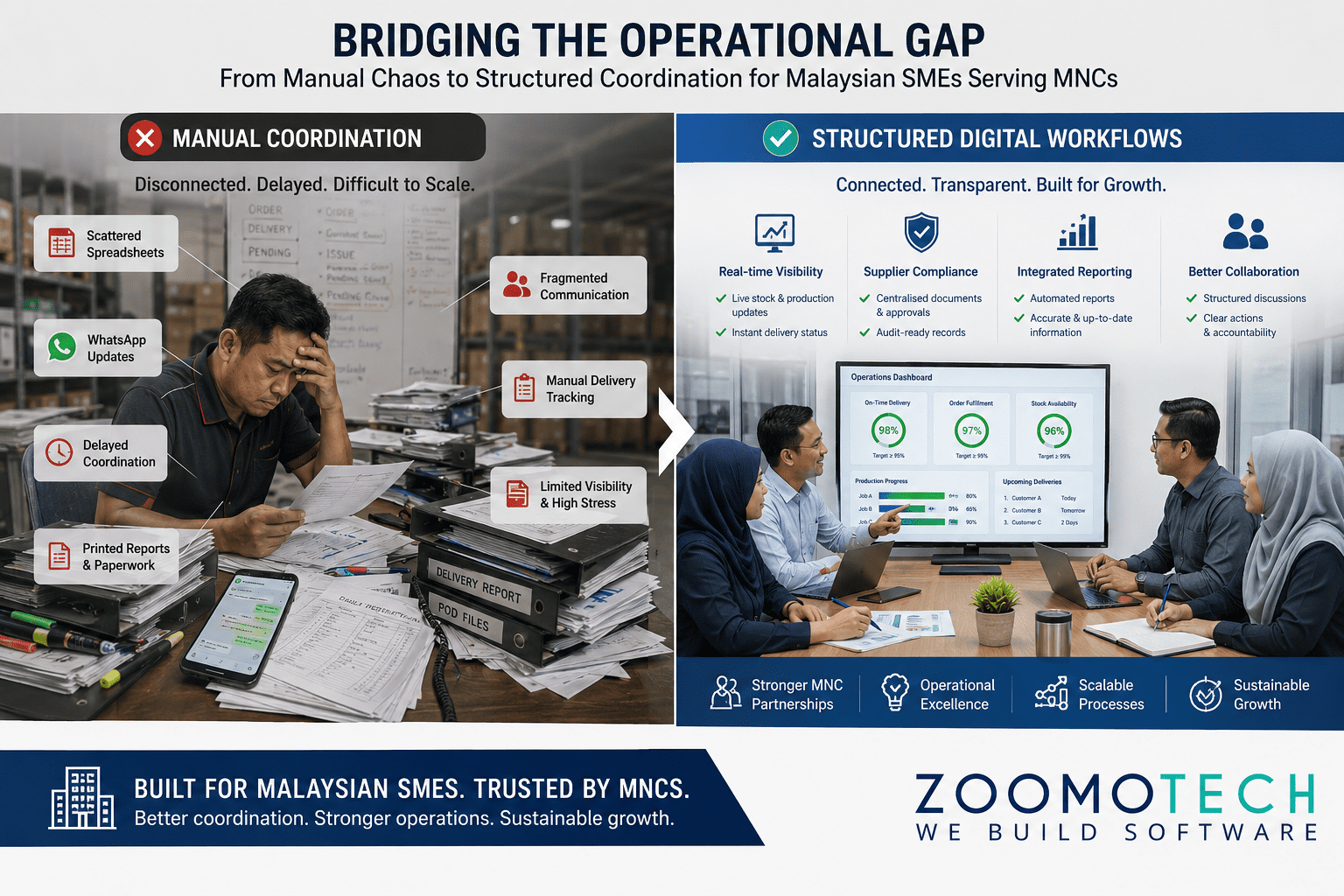
Many Malaysian SMEs still track orders, stock movement, and delivery updates through spreadsheets, WhatsApp messages, printed documents, and verbal coordination between departments. That approach may still work internally, but large customers like MNCs, GLCs, and major retail groups increasingly expect faster reporting, structured audit records, and quicker operational updates whenever delivery schedules or production status suddenly change.
A delayed stock update, missing quality document, or unclear shipment status can slowly position a supplier as operationally risky, even when product quality remains acceptable. Supply Chain Digitalisation is gradually becoming part of supplier qualification expectations because global customers now prioritise coordination stability, reporting speed, and operational consistency alongside pricing.
What is Supply Chain Digitalisation for Malaysian SMEs
Supply Chain Digitalisation helps Malaysian SMEs replace fragmented manual coordination with structured workflows that support faster reporting, lower coordination mistakes, and better integration with enterprise customer requirements.
- Shared operational records between suppliers and customers
- Faster document preparation for audits and procurement
- Reduced delivery and fulfilment coordination mistakes
- Better tracking across purchasing, production, and logistics
- Easier integration with customer procurement systems
Why Manual Coordination Fails When Dealing With MNCs
Many Malaysian SMEs built successful operations through experience, fast decision-making, and strong relationships. That approach worked well when customer expectations were slower and reporting cycles were less demanding.
Today, MNCs and large retail groups operate using live operational data, structured audit trails, and integrated procurement workflows. A delayed spreadsheet update, missing WhatsApp reply, or unclear stock status can affect purchasing decisions, production schedules, and delivery planning across multiple parties. The issue is no longer about staff effort alone. The gap now comes from coordination speed, reporting structure, and response consistency.
Meeting Global Standards With a Supplier Compliance System
Large organisations increasingly evaluate suppliers using structured scorecards covering delivery performance, response time, documentation quality, and operational consistency. Many Malaysian SMEs still prepare reports manually during audits, creating unnecessary staff pressure and inconsistent documentation during customer reviews.
A Supplier Compliance System helps standardise quality records, batch traceability, and approval workflows across departments. This reduces manual preparation work while improving reporting consistency during customer audits, site visits, and procurement reviews. Over time, structured operational records slowly become part of how customers evaluate supplier reliability and long-term operational stability.
Why Supply Chain Digitalisation Reduces Your Operational Costs
Many SMEs assume digitalisation only increases business cost because they focus on software investment alone. In reality, a large portion of operational cost often comes from repeated coordination, document handling, approval delays, and manual verification between customers, suppliers, and internal departments.
Supply Chain Digitalisation reduces repetitive administrative work by connecting operational data across purchasing, production, logistics, and customer communication. Faster approvals shorten payment cycles while electronic document sharing reduces printing, courier, and manual filing activities. Better planning accuracy also reduces urgent shipment costs, rejected deliveries, and costly correction work after fulfilment mistakes happen.
Protecting Your Contracts From Digital-Ready Competitors
Many long-term suppliers assume stable relationships alone are enough to protect existing customer contracts. However, larger customers increasingly compare vendors based on responsiveness, reporting capability, and operational coordination speed during disruptions, production changes, or urgent delivery requests.
Competitors using structured systems can often provide faster updates, more accurate lead times, and clearer operational reporting during customer reviews. A supplier that still relies heavily on manual coordination gradually becomes a business risk when customers depend on faster decision-making across multiple factories, warehouses, and procurement teams. In many industries, retaining an existing customer costs far less than recovering lost trust later.
How Shared Data Improves Your Client Relationship Management
Most operational conflicts between suppliers and customers start when information arrives too late, incomplete, or inconsistent across departments. Customers become frustrated when delivery status, stock availability, or production updates require repeated follow-up from different staff members.
Shared operational data improves coordination by allowing both parties to react earlier during delays, material shortages, or production changes. Automated alerts support faster communication while structured reporting reduces miscommunication during urgent situations. Over time, suppliers who communicate proactively often move beyond transactional vendor relationships into more trusted long-term operational partnerships.
Scaling Your Production Capacity Without Increasing Staff Count
Business growth often increases coordination faster than production efficiency. As customer orders expand, many SMEs add more coordinators, admin staff, and manual checking processes just to maintain daily operations, approvals, and reporting requirements.
Structured systems help existing teams manage higher operational volume without depending entirely on additional manpower, especially as Malaysia continues facing long-term labour productivity and workforce challenges within manufacturing industries. Standardised workflows reduce repeated checking, duplicated communication, and manual tracking between departments. This supports more stable operational growth while preparing the company for future labour shortages, rising staffing costs, and more demanding customer reporting expectations.
Digital Readiness Determines Your Future Company Valuation
Many SME owners still evaluate operational systems as an internal cost rather than a long-term business asset. However, buyers, investors, large customers, and strategic partners increasingly assess whether a company can scale consistently without depending heavily on specific individuals, manual coordination, or owner involvement in daily decisions.
Structured workflows, integrated operational records, and standardised reporting gradually strengthen business continuity and operational confidence. A company with proven systems often appears more scalable, more stable, and easier to manage compared to one that relies mainly on experience, paperwork, and informal coordination. Over time, operational maturity becomes part of the company’s commercial value, succession readiness, and long-term sustainability.
Transition From Reactive Fixing to Strategic System Planning
Many SMEs only review their operational structure after customer pressure, audit findings, or repeated coordination problems begin affecting daily operations. A more stable approach is to improve one important workflow at a time, starting with the areas customers value most. Clarity before commitment reduces unnecessary disruption while phased implementation creates room for controlled growth, internal learning, and better long-term decision making.
Secure Your Place in the Modern Supply Chain
A significant number of established SMEs have strong products, experienced teams, and loyal customers, but operational expectations are changing faster than traditional coordination methods can support. Supply Chain Digitalisation does not need to begin through one large system project immediately. The more important step is identifying where coordination friction already exists today. Early preparation allows companies to improve gradually, reduce future disruption, and strengthen long-term customer confidence before external pressure becomes harder to manage.
If some of these situations sound familiar, a simple discussion through WhatsApp or Email may help you identify where the coordination gaps actually begin before making any major system decisions. There is no need to rush into software immediately. Sometimes, understanding the root coordination issues clearly is already a good first step.
—
Ning
Founder, Zoomo Tech