
When an SME starts comparing software vendors, one question often comes up early: “How many programmers do you have?” Software Development Team Size can quickly become part of that judgement. A company with 20 or 30 people can feel safer than one with only 3 to 5. For an owner spending serious money on a business system, that reaction is understandable. You want enough people behind the project if something goes wrong.
The concern becomes clearer when your project sounds complicated. Sales, purchasing, production, inventory and accounts may all be tied together, yet the vendor says only a small team will handle it. At that point, the size of the team can become a shortcut for judging whether the vendor has enough capability to handle the project.
Software Development Team Size Does Not Guarantee Success
Team size alone cannot predict whether an SME project will succeed, because delivery depends more on:
- Clear understanding of business requirements
- Relevant project experience
- Strong coordination between team members
- Stable working relationships and communication
- The capability of the people actually assigned to the project
Why SME Projects Need More Than Headcount
A custom system for an SME often reflects the company’s actual way of working. A factory may have its own production approvals, stock movements, quality checks and reporting routines. A logistics company may follow different dispatch and delivery processes. More people in the software team do not automatically mean they will understand these details better.
There is also a practical communication issue. As more people join a project, more communication points appear between sales, consultants, developers and managers. That structure can work well when roles are clear. It does not remove the need for the right people to understand the business properly. For the customer, the more useful question is not simply how many people a vendor has, but who will actually understand and deliver the project.
Company Headcount Does Not Equal Project Capacity
A software company with 20 or 30 people does not mean all 20 or 30 people will work on your project. Developers usually handle several customer projects at the same time. Some team members may also be involved in sales, management, internal systems or support. A large company can therefore have a large headcount while assigning only a small group to your SME project.
This is why company size can give a misleading impression of project capacity. If you are searching for a Software Development Company Malaysia, do not stop at the company profile. Look at the people actually assigned to your project. Their roles, availability and responsibility will tell you much more than the total number of employees.
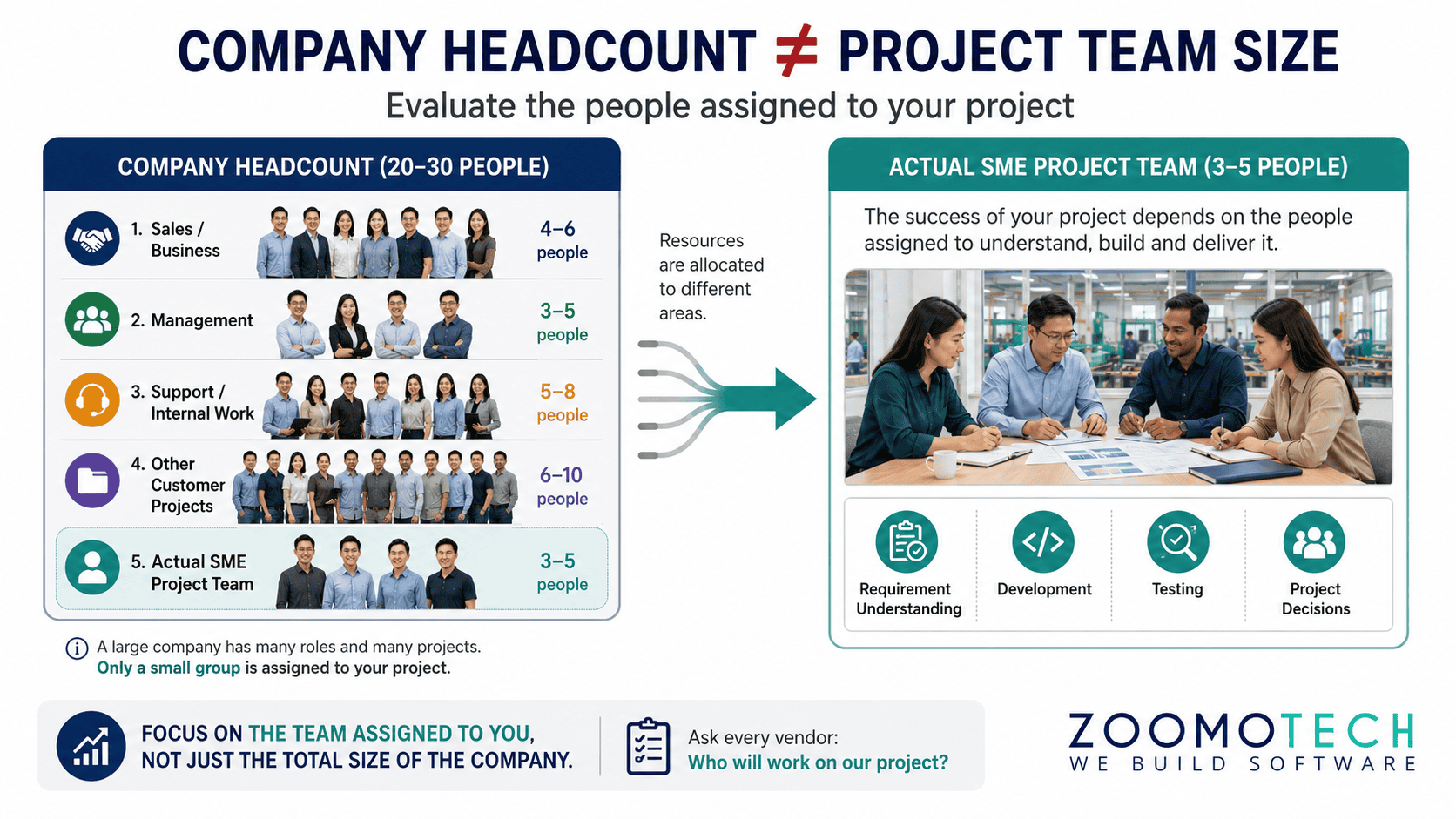
The People Assigned Matter More Than Total Headcount
Before selecting a vendor, ask who will actually handle the project. Find out who collects requirements and who makes technical decisions. Ask who remains involved after development starts. A vendor may have a large organisation, but your project could still depend on a small delivery team. The important point is knowing exactly who carries the responsibility.
Senior involvement also matters. Some vendors may place experienced people in the early sales discussion, then assign different staff after the project begins. That is not necessarily wrong, but you should understand the arrangement, especially because unclear decision ownership can slow ERP implementation progress. When comparing vendors from a Software Development Company Malaysia search, ask who will work with you, what each person does and how decisions will be made.
Long Working Relationships Improve Team Coordination
A team that has worked together for many years develops a practical understanding of each person’s strengths. They know who is better at analysing a difficult requirement and who handles a particular type of technical problem. They also know when to ask another team member for input. This reduces unnecessary internal explanation and helps people divide work more naturally.
That does not mean a long-working team will always deliver better results. However, familiar working relationships can reduce coordination friction. A smaller team that already understands how its members think and communicate can work more efficiently than a larger group that is still learning how to work together. Good coordination is a delivery capability in its own right, especially when the same team remains involved throughout the projectrather than changing halfway through.
Requirement Understanding Separates Coding From Real Delivery
A software project does not begin with programming. It begins with understanding how the business actually operates. A manufacturer may have different approval steps for raw materials, production and finished goods. A logistics company may have its own dispatch, delivery and proof-of-delivery process. These details often matter more than the screen or button being requested.
When a team misunderstands the workflow, it can still produce software that works technically but does not work for the business. This is one reason standard ERP software can fail to fit unique SME workflows, especially when the business has developed its own approval rules and operating practices. Good requirement analysis must uncover these differences before development goes too far. Experienced teams can also spot missing requirements and edge cases earlier, before they become expensive changes.
Experience Matters When Business Problems Get Complicated
Previous projects expose developers to different business situations. They may have handled production planning, stock movements, customer orders, service appointments or internal approvals before. Each project adds practical lessons about what works, what creates problems and what information needs closer attention. Those lessons become useful when a new customer brings unfamiliar requirements.
Experience does not replace proper requirement gathering, but it helps the team ask better questions earlier. It can also help identify technical or workflow risks before they become expensive changes. For an SME, Software Development Team Size matters less than the experience behind the people involved. It also needs accumulated experience in understanding business problems, making practical decisions and delivering systems that people can actually use.
What a Software Development Company Malaysia Should Show
When an SME chooses a development partner, the risk is not limited to whether the software can be coded. Poor requirement understanding can create rework, delayed operations, staff frustration and extra cost. A reliable vendor should show relevant project experience and explain workflows in business language. It should also provide a clear process for requirements, development, testing and delivery, consistent with the principles described in software quality management for computer software.
Management should also know who remains accountable when problems arise. Direct access to responsible decision-makers, honest answers about project risks and limitations, and evidence of understanding SME operating realities provide stronger assurance than headcount alone. When a difficult decision arises, management should know who has the authority to act. The real question is whether the vendor can take responsibility for the business problem, not simply whether it has many people.
Choose Capability, Not Headcount, for Your Next Project
A sensible approach is to assess the actual team, business understanding and working relationship before judging company size. Clarity should come before commitment, with a phased approach that allows risks to surface early. The aim is to understand the real problem before committing to a larger solution.
The Right Team Matters More Than a Bigger Team
A bigger vendor can bring useful resources, but size alone does not make a project safer. A smaller team can also carry risk. What matters is how the team works, how well it understands your business and how responsibly the project is managed. The real measure of Software Development Team Size is not the number on the company profile. It is the capability, experience, communication and discipline behind the people assigned to your project. Ask better questions before deciding which vendor deserves your trust.
Still wondering whether a small development team can handle your business system? You can share your workflow or current challenges with me through WhatsApp or Email. There is no need to prepare a formal requirement first. Even a simple description of the current problem is enough to start a private discussion, with no obligation to proceed.
—
Ning
Founder, Zoomo Tech