
Your system may run normally every day, with staff logging in, customers browsing, and orders coming through without much trouble. Then a live-selling session or major promotion starts, and the traffic changes within minutes. Pages become slower, orders arrive together, then your IT team starts watching the server, database and network more closely. Scalable System Architecture suddenly becomes a practical concern.
The traffic does not simply “hit the server” as one uniform workload. Different parts of the system may become busy at the same time, while one dependency can quietly slow down the whole workflow. Adding more servers may help, but it might not fully solve the underlying problem.
How Scalable System Architecture Handles Traffic Spikes?
A scalable architecture allows a system to increase its capacity for peak demand without requiring every component to be replaced or oversized from the start.
- Scale up: Give an existing server more CPU, memory or other resources.
- Scale out: Add application nodes and distribute requests across them.
- Application layer: Process requests across available nodes.
- Database and storage: Handle increased workload without becoming bottlenecks.
- Network and external services: Handle higher traffic and dependent requests.
- Peak planning: Design for realistic expected demand, not an unlimited theoretical maximum.
Traffic Spikes Expose the System’s Hidden Dependencies
A traffic spike does not simply put pressure on one server. A customer request may pass through the application, database, session handling, file storage and external services before the transaction is complete. The system works as a chain, so one constrained component can affect the whole workflow.
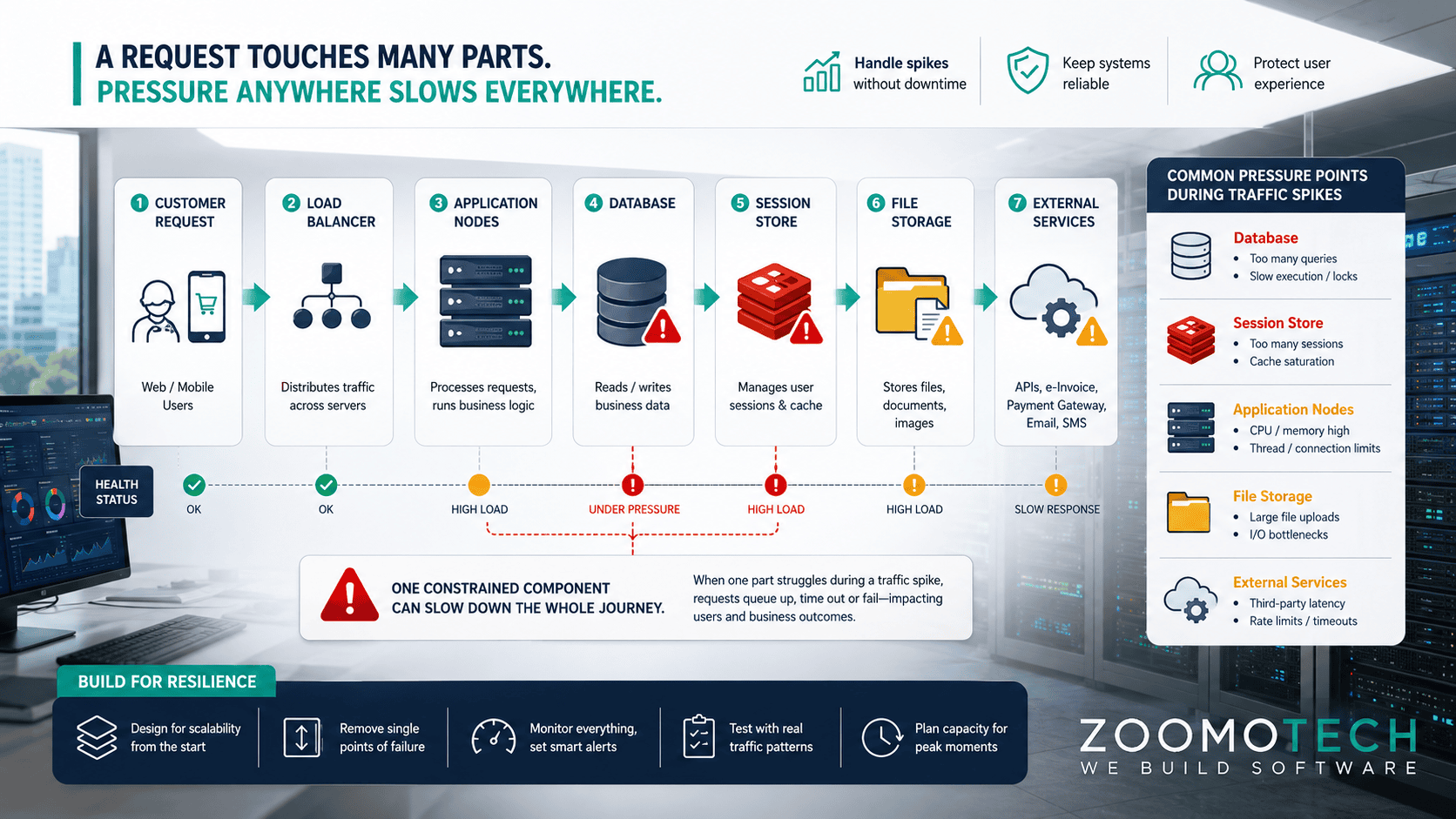
This is not necessarily a sign that the system was designed badly. Many systems start with a reasonable architecture for normal usage, then business activity grows and new requirements are added over time. Multiple application nodes may still depend on one database or shared resource. Understanding these dependencies is therefore the starting point before deciding how the application should scale.
Application Nodes Distribute Requests Across Servers
An application node is simply a running instance of the application that processes user requests. During a traffic spike, one server may become overloaded. Multiple nodes can spread the workload, so one server does not have to handle everything. This is known as scaling out or horizontal scaling. A load balancer can sit between users and these nodes, directing requests to available servers.
Adding nodes does not automatically make the application scalable. Requests must be able to move between nodes without depending on one particular server. Good Traffic Spike Handling therefore starts with application design, not just adding more machines. Scalable System Architecture depends on whether the application can use that additional capacity.
Database Bottlenecks Can Limit Scaling
Suppose an application now runs across three nodes. All three may still depend on the same SQL Server database. If that database becomes overloaded, adding a fourth or fifth node may provide little improvement. The bottleneck has simply moved elsewhere. This can happen when many users read and write data at the same time, when database queries take too long, or when transactions compete for the same records.
This matters even more for transaction-heavy systems. During a busy sales campaign, order creation, stock checking, payment updates and other database actions may happen together. Database optimisation is therefore part of scalability planning, not a separate exercise. Before adding more capacity, IT teams should identify the component that is actually limiting performance.
Session State Matters When Systems Scale Out
User sessions can create another problem when requests are spread across multiple nodes. In a simpler setup, a user’s login session may be stored on the server that handled the previous request. Once traffic is distributed, the next request may reach a different node. If that node cannot access the same session information, the user may appear logged out or lose part of the transaction.
A shared or centralised approach keeps session information available to the required nodes. This supports consistent login behaviour, session expiry and authentication across the system. It also reduces dependence on one server. Session design made early can affect future scaling options, especially when the system is expected to grow beyond one application server.
Shared Files Become a Concern Across Multiple Nodes
Files can create a similar problem. Imagine a user uploads an invoice attachment, product image or document, and the file is stored only on the node handling that request. A later request may reach another node that cannot find the file because the file is not located within the node local storage. The application may appear to work, but the user sees a missing document or broken image.
A shared or external storage arrangement can give all nodes access to the same files. This may include uploaded documents, product images, generated reports and other business records. The important point is that application nodes should not become isolated storage locations when the system needs to scale out. Storage design should therefore allow any node to access the files where the application needs.
Load Balancing Connects Users to Available Nodes
A load balancer acts as the traffic controller between users and application nodes. When requests arrive, it decides which available node should receive them. It can also perform basic health checks and stop sending new requests to a node that is no longer responding properly. This can help the application continue operating when one node becomes unavailable.
However, load balancing alone does not create scalability. It only distributes the requests. Traffic Spike Handling still depends on whether the application nodes, database, storage and external services can handle the combined workload. A well-designed system therefore treats load balancing as one part of the architecture, rather than expecting it to solve every performance problem.
Architecture Review Checklist
Before adding more servers or enabling auto-scaling, IT teams should check:
- Application: Can requests run across multiple nodes without depending on one server?
- Database: Is SQL Server becoming the main performance bottleneck?
- Sessions: Can user sessions remain available when requests move between nodes?
- Storage: Can every node access the files required by the application?
- External services: Can payment gateways, APIs and other services handle the same peak workload?
The objective is not to add more capacity everywhere. It is to identify the actual constraint first.
IT Teams Need More Than Auto Scaling
Adding more capacity sounds simple when traffic rises, but auto-scaling only helps when the application is ready to scale. A database, shared storage or third-party API may still become the limiting factor. Scaling too aggressively can increase infrastructure costs without solving the real issue. This is why your IT teams need to look beyond server capacity.
Monitoring provides the evidence needed to understand when and where scaling should happen. From a management perspective, the decision is not only about performance. It also involves system reliability, operating cost and ease of maintenance, as well as the potential business impact if the system fails during a critical sales or operational period.
Architecture Should Match Business Risk and Demand
Not every system needs multiple nodes or auto-scaling from the start. A phased approach allows capacity to grow as demand becomes clearer. Start with clarity before commitment, identify the real risk, then add complexity where the business needs it. The aim is sensible risk control, with the right balance of performance, resilience and long-term maintenance costs.
Build Scalable System Architecture Around Real Workloads
Scalability starts by understanding how the application behaves when demand rises, not by deciding how many servers to buy. Application nodes, databases, sessions, storage and load balancing all need to work together. The right number of nodes is therefore an architectural outcome, not the starting requirement. Testing before a major traffic event can validate assumptions, expose bottlenecks and reduce surprises. A Scalable System Architecture should provide the right balance of performance, reliability and cost.
A major campaign can expose gaps that normal operations never reveal. If you are reviewing your architecture before a peak event, feel free to reach me through WhatsApp or Email for a private discussion. We can first understand the situation and possible risks, with no obligation to proceed.
—
Ning
Founder, Zoomo Tech