Your company has paid for a custom system, the staff are using it every day, and the project is completed as per schedule. Then the software company quotes an additional Source Code Handover fee. The immediate question is simple: “We already paid for the system. Why do we need to pay again?”
This situation can feel confusing, especially when the system was built specifically for your company. Your staff see the screens, key-in information, generate reports and manage daily work through the system. But they usually never see what sits behind those screens. And most SME owners only think about the development behind the screens when the software vendor discusses handover, future changes or support.
The question becomes more important when the system becomes part of your daily operations. Your custom-made production system, ERP or operational workflow can become costly to replace when the original software company is no longer available. However, before looking at the source code handover fee, it is important to understand what source code actually is and what your company is paying for.
What Is Source Code Handover for an SME
A Source Code Handover means the software company transfers the programming code used to build, modify and maintain the custom system to the customer.
- Source code is the programming code programmers use to build, change and maintain the system.
- It is different from the login access used to open the system.
- Receiving source code does not automatically transfer copyright or other IP rights.
- The source code handover agreement should clearly state what the customer can access, modify, reuse or transfer.
Your Custom System Is More Than What Your Staff See
When your staff login to the system every morning, they see screens, forms, reports and workflows. That is the working part of the system they interact with. Behind those screens are programming codes, files and components that software developers use to build, change and maintain the system. In practice, your company can use the system every day without receiving the underlying code.
The same applies to commercial software, where a company may use it through a subscription or licence without receiving the underlying code. Custom software is different because it is built around one company’s specific workflow and requirements. That creates a separate discussion about what was delivered and what rights were agreed. But in reality, paying for development alone does not automatically answer all of these questions.
The next practical question is: why is the code sometimes priced separately?
Source Code Handover Costs More Than File Transfer
Once the source code is discussed, the next question is usually the fee. The fee covers more than a simple file transfer. The software company may need to check the codebase and prepare the relevant files. It may also organise documentation and confirm the handover matches the agreed system version.
There can also be practical complications. Some projects use frameworks, libraries or other components with their own licence conditions. The software company may also need to explain deployment steps or support a transition to another technical team.
That work takes time. The Source Code Handover fee therefore does not necessarily mean you are paying for someone to copy files. It may cover preparing, organising and transferring the development materials. Therefore, the agreement should separately define any rights, documentation or transition support included.
The System You Use and Source Code Are Different
Your staff use the system to enter orders, update production records, check stock or prepare reports every day. They do not need to understand the programming behind those screens. Source code serves a different purpose. It is the language that a programmer uses to design how the system works, make changes and add new functions.
That distinction matters when technical support is no longer provided. A working system can continue running without source code access. But major changes, difficult problems or a move to another software company may require deeper technical access. The handover is mainly about future technical control, not daily system use. This becomes especially important when your software vendor is no longer available and another company needs to take over the system.
Source Code Ownership Is Not the Same as Access
Having the source-code files in your company does not tell you who owns the rights to them. Ownership of those rights depends on what the software agreement says and what copyrights ownership were actually transferred. The customer may receive access to the code while some intellectual property rights remain with the software company.
This is why the wording in the agreement matters. The agreement should therefore state what rights the customer receives, including whether the customer can use, modify and transfer the code. Pre-existing components and third-party libraries may also have separate conditions. Source Code Handover should therefore be treated as a contractual matter, not simply a technical file transfer.
When Buying Source Code Makes Business Sense
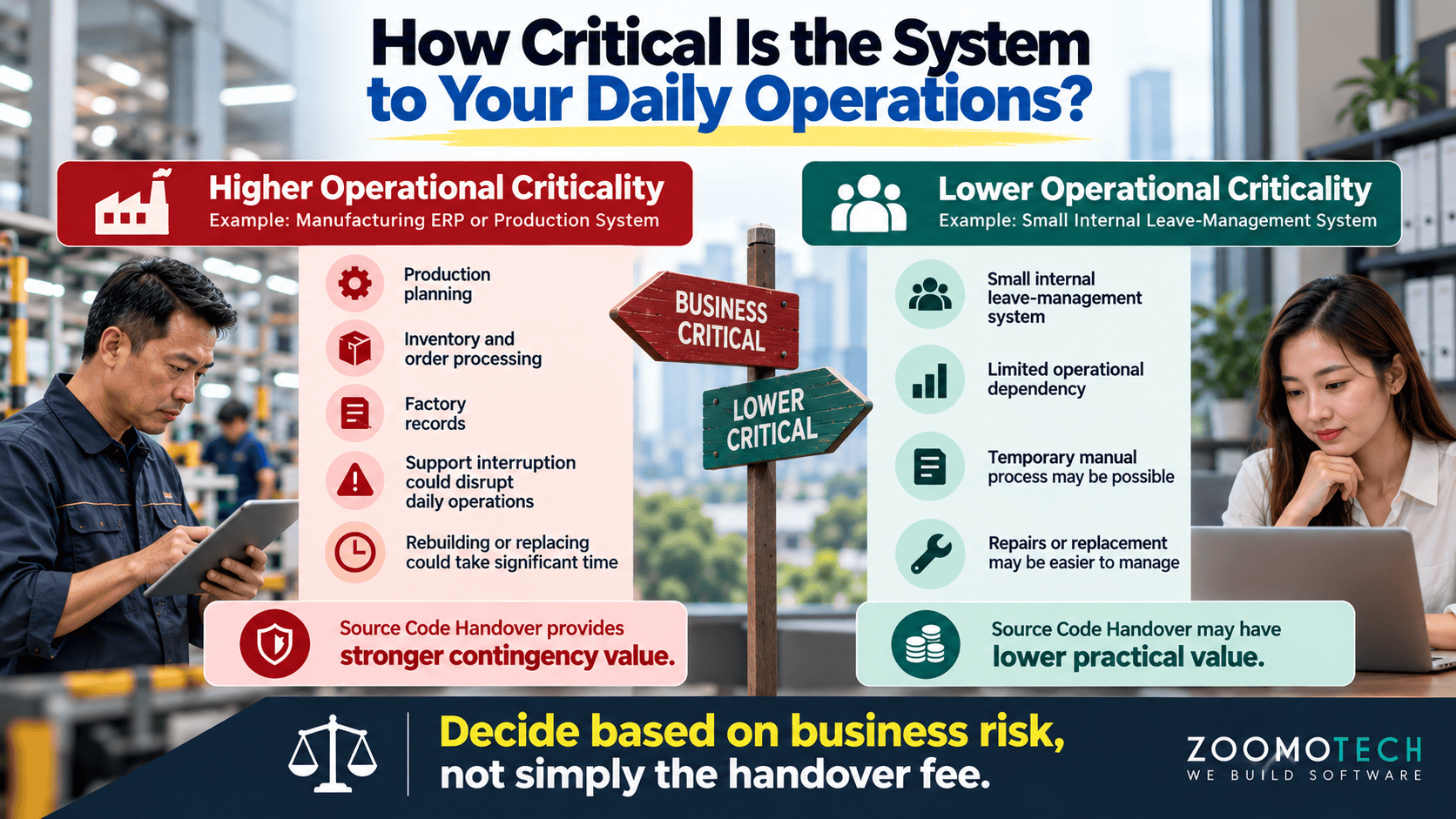
The decision to buy source code should start with how critical the system is to your company operations, rather than simply looking at the cost of the handover. A manufacturing company may depend on one custom system for production planning, inventory, order processing and factory records. Losing support for that system could affect daily operations and take considerable time to recover.
On the flip side, a small internal leave-management system may be different. If it stops working, the company may still manage the process manually temporarily while repairs are arranged. Source Code Handover can be more valuable when rebuilding the system would take significant time and disrupt operations. For an SME owner, the better question is not “Should I own the code?” Ask instead, “What would happen if I could no longer get support for this system?”
Source Code Access Creates New Responsibilities
Source code gives a company more options, but at the same time it also creates new responsibilities. Company must treat the source code files as confidential business information. That code may reveal workflows, rules, relationships and other details about how the company operates. More importantly, anyone with the right technical access may also be able to change the system.
That means access should be controlled carefully. The company should know who holds the repository, credentials and deployment materials. It should also keep proper backups, access records, and confirm that the handover contains the latest agreed production version.
Source Code Ownership also means the company should decide who is authorised to access, copy or change the code. A clear access controls help reduce the risk of unauthorised changes and make responsibility easier to manage.
The Handover Terms Matter More Than the Price
From management perspective, the key question is what the fee actually covers and what the company can control afterwards. A low source code handover fee with unclear terms may provide little protection. A properly defined handover can preserve future options when the system becomes business-critical. This is also why understanding custom software cost in Malaysia is important before agreeing to additional project costs.
Before signing the agreement, confirm the following:
- the exact source code version being transferred
- whether documentation, database details and deployment materials are included
- what rights the company own to modify, reuse or transfer the code
- whether future versions or enhancements require another payment
Management should know whether the company can modify, reproduce, transfer or appoint another software company to maintain. Similarly, the software company’s remaining rights should also be clearly stated. These details matter because the handover should address the business continuity risk the company is trying to manage, not simply complete a technical transfer.
Treat Source Code as a Contingency Protection
The decision to pay for source code is best viewed as a form of contingency protection, not another software feature. Its value becomes clearer when the system supports important daily operations and the cost of losing support is high. Company should decide based on the business risk, not on the idea of owning code for its own sake.
However, owning the code does not mean ending the relationship with the original software company. Good maintenance and support may still remain important. Even after receiving the source code, ongoing software maintenance service may still be needed to keep the system running properly.
Know What You Paid for Before Signing Off
Paying for a custom system does not, by itself, determine what source code and intellectual property rights you will receive. Before signing off, make sure you understand what you are receiving: the working system, the source code and the rights attached to each. Review the handover scope, latest version and future enhancement terms. Then decide whether Source Code Handover is worthwhile based on how critical the system is to your business. Treat the decision as part of long-term software investment planning, not simply another project cost.
The source-code discussion is easier to settle before development starts than after the project is completed. If you are planning to have a custom system and are unsure what should be included, feel free to reach me via WhatsApp or email. We can have a private discussion about the scope, source code rights and support expectations, without any obligation to proceed.
—
Ning
Founder, Zoomo Tech